
.avif)






%201.svg)

In December 2025, the cybersecurity community was reminded how quickly a single software flaw can cascade into large-scale cloud risk. The React2Shell vulnerability (CVE-2025-55182)—a critical, unauthenticated remote code execution (RCE) issue in React Server Components’ Flight protocol—allows attackers to execute arbitrary code on vulnerable servers using a single crafted HTTP request. React and downstream frameworks responded quickly with patches. But as Unosecur’s cloud identity research team assessed the situation, one conclusion stood out: the vulnerability itself is only the opening move.
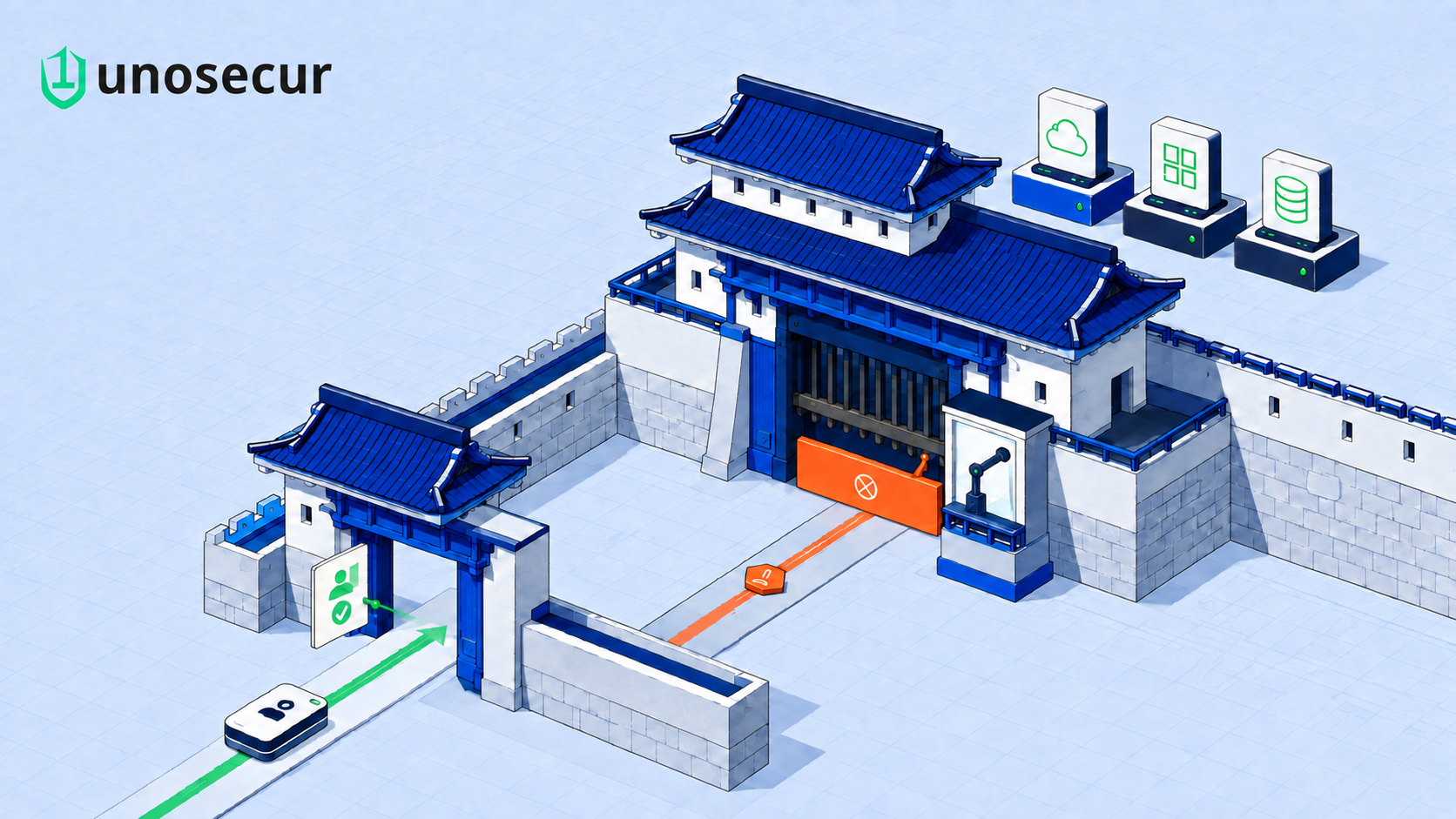
Once attackers achieve code execution in a cloud environment, they rarely stop at running unauthorized processes. They pivot toward the identity layer—service roles, instance identities, API tokens, and permissions—because identity determines how far they can expand, how long they can persist, and how much damage they can cause. This is why React2Shell offers a broader lesson for cloud defenders: identity is the real perimeter, and identity security is the decisive control for preventing post-exploitation escalation. That is precisely where Unosecur’s identity security platform provides leverage.
Why Identity Matters After Exploitation
An exploit like React2Shell provides initial access. What follows determines whether the incident is contained or becomes a breach.
In cloud environments, attackers commonly attempt to leverage identities to:
- Abuse compute engine IAM roles attached to VMs, containers, or serverless workloads
- Deploy cryptomining or resource-abuse workloads using legitimate permissions
- Escalate privileges by exploiting overly broad access scopes
- Move laterally across services and accounts via cloud APIs
- Establish persistence by creating or modifying service accounts, roles, or keys
In other words, identity defines the blast radius. A compromised workload with minimal permissions is a nuisance. A compromised workload with excessive IAM access is a platform-wide risk. Patching vulnerable libraries is essential, but patching alone does not reveal whether identities were abused during the exposure window. That visibility gap is where most cloud breaches quietly unfold.
React Patch Update: Necessary, but Not Sufficient
Following disclosure, the React team released patched versions of the affected React Server Components, and frameworks such as Next.js incorporated those fixes. The guidance was clear: upgrade immediately and assume exposed services may have been targeted.
From Unosecur’s perspective, this distinction matters:
- Patching closes the vulnerability
- Identity analysis determines impact
Security teams must still answer critical questions after patching:
- Were workloads exploited before remediation?
- Which identities were accessible from those workloads?
- Did any identities behave abnormally during the exposure window?
- Were new access paths created that persist beyond the patch?
This is where identity-centric detection becomes indispensable.
Unosecur: Identity-First Security for Cloud Environments
Unosecur is an AI-driven cloud identity security platform built to detect, analyze, and mitigate identity threats across AWS, Azure, and GCP. Rather than treating identity as a static configuration, Unosecur treats it as a continuous security signal—tracking who accesses what, how, when, and why. Here’s how Unosecur
helps organizations defend against identity-centric attacks following exploits like React2Shell.
1. Unified Identity Visibility and Blast Radius Mapping
Modern cloud environments contain thousands of identities: humans, service accounts, compute roles, CI/CD pipelines, SaaS integrations, and automated agents. Unosecur discovers and inventories every identity—human and non-human—and maps their permissions, access paths, and reachable resources across clouds. After a compute compromise, this visibility is critical. If an attacker gains access to a workload with an attached IAM role, Unosecur immediately shows what that identity can touch, enabling rapid risk assessment and containment.
2. Real-Time Identity Threat Detection and Behavioral Monitoring
Unosecur continuously learns baseline behavior for every identity and flags anomalies in near real time, including:
- Compute identities making unusual or high-risk API calls
- Privilege escalation or identity-management actions outside normal patterns
- Abnormal token usage or access timing
- Cloud activity is inconsistent with historical behavior
This allows Unosecur to detect post-exploitation activity—such as cryptomining deployment or lateral movement—as it happens, not days later in log reviews.
3. No-Code Automated Remediation and IAMOps
Detection without response is incomplete. Unosecur enables automated remediation through no-code IAMOps workflows, allowing teams to:
- Revoke or rotate compromised credentials
- Disable or quarantine suspicious identities
- Enforce least-privilege dynamically
- Apply secure IAM policy changes without scripting
When a compute identity suddenly behaves like an attacker, Unosecur can respond immediately—reducing dwell time and limiting damage.
4. Continuous Least-Privilege Enforcement
Over-privileged identities are one of the most common enablers of post-exploit escalation. Unosecur continuously evaluates permissions to:
- Detect entitlement creep
- Identify unused or excessive access
- Recommend and enforce least-privilege policies
In practical terms, even if React2Shell leads to code execution, restricted identity permissions dramatically reduce what an attacker can achieve.
5. Audit, Compliance, and Forensic Visibility
Unosecur provides deep audit and forensic insight into identity activity, supporting:
- Incident investigation and root-cause analysis
- Regulatory and compliance reporting
- Verification of access controls and remediation actions
This allows teams to reconstruct timelines, understand identity misuse, and prevent recurrence—not just clean up symptoms.
6. Agentless, Multi-Cloud Deployment
Unosecur operates agentlessly, integrating directly with AWS, Azure, and GCP without intrusive software. Organizations can deploy quickly and gain value in hours, not months. This makes identity security achievable even for teams managing complex, multi-cloud environments with limited operational bandwidth.
Securing Compute Engines Against Identity-Based Abuse
Exploits like React2Shell commonly begin with compute access and escalate through identity abuse. Without identity intelligence, attacker activity often looks like normal cloud operations.
Unosecur prevents this by:
- Detecting abnormal API usage from compute identities
- Identifying cryptomining and resource abuse tied to IAM activity
- Flagging lateral movement attempts through cloud services
- Automatically containing identities before persistence is established
This identity-centric approach prevents attackers from quietly “living off the land” using legitimate credentials.
Conclusion: Identity Is the Foundation of Cloud Security
React2Shell reinforces a reality cloud defenders can no longer ignore: patching fixes vulnerabilities, not consequences. What determines whether an incident becomes a breach is what happens after exploitation—and in cloud environments, that almost always involves identities.
Unosecur enables identity-first cloud defense by delivering:
- Continuous visibility into identity permissions and access paths
- Real-time detection of identity abuse
- Automated remediation and IAM hardening
- Scalable, agentless multi-cloud protection
In an era where identity is the new perimeter, organizations must treat identity security as foundational infrastructure—not an afterthought. Threats like
React2Shell makes that imperative clear, and Unosecur provides the tools to act on it.



.png)
.png)
%201.svg)




.webp)

.avif)