.avif)





%201.svg)
Security teams are used to fires. Stolen credentials. Misconfigured policies. Brute-force attempts. These incidents are dramatic, visible, and in mature security programs, they’re well-instrumented. Most security tooling is designed to detect exactly these kinds of issues.
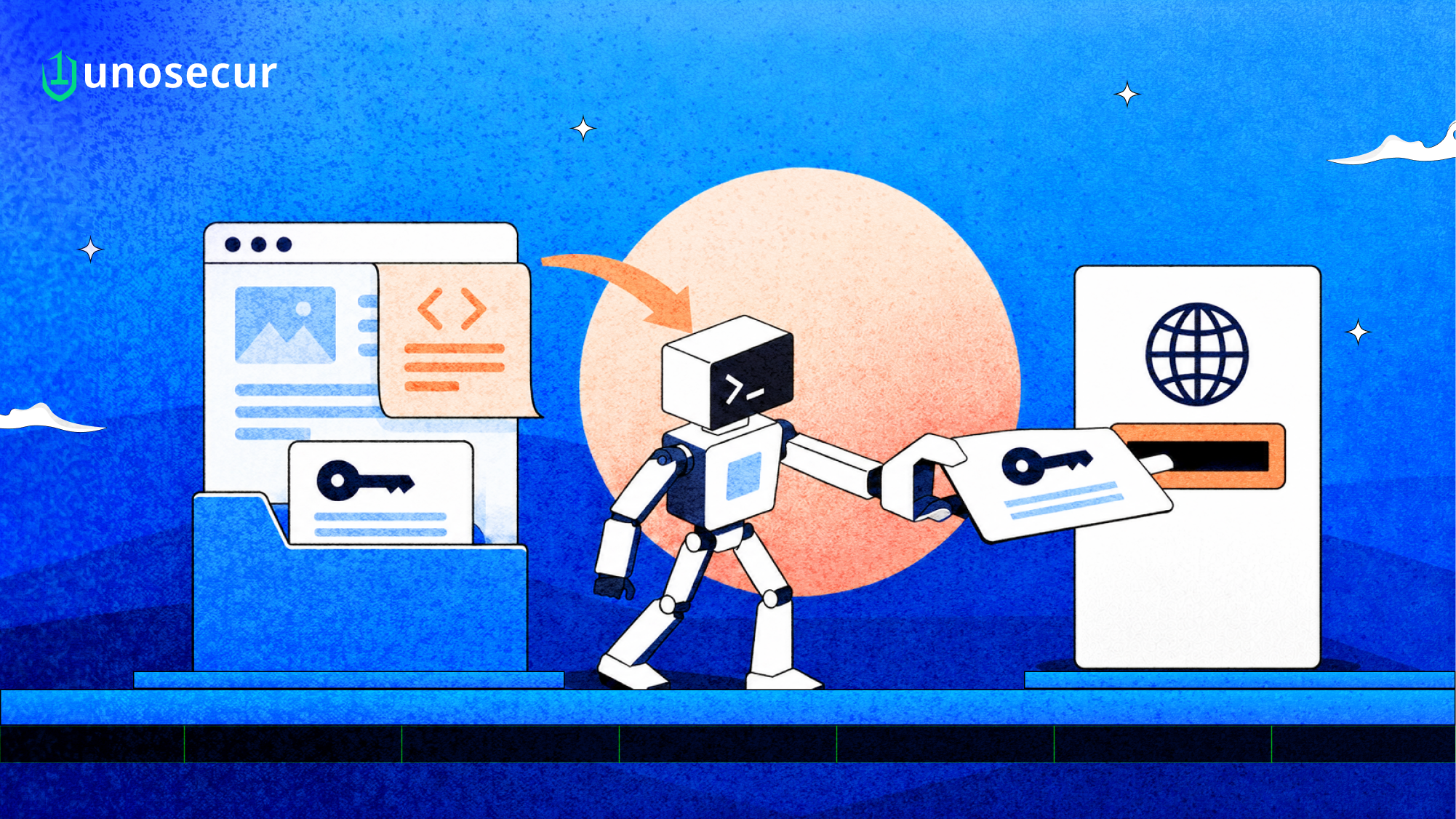
Model Context Protocol (MCP) doesn’t fail that way. Consider an AI agent that has been running quietly in your environment for weeks. It was created with a clear task. Its permissions were broad enough to “just work.” Its existence persists, and day by day, it learns more about its access and what its capabilities are.
Nothing broke. Nothing failed authentication. Nothing triggered an alert. Until someone realized the agent was now interacting with systems way outside its original scope. This is the defining risk pattern of MCP-driven systems. It’s not that there is a visible misconfiguration; it's the drift from allowed to unintended to dangerous. Security teams must surface the new risk markers that come with MCP and Agentic AI before that drift becomes an incident.
MCP security is not a tooling problem
Model Context Protocol does not introduce a new class of vulnerabilities.
It introduces a new way for identity, context, and permissions to combine and accumulate silently. Most MCP-related concerns are not related to missing MFA, leaked keys, or broken IAM policies. They happen because agents behave exactly as they are allowed to behave, and no one can confidently answer:
- What is this agent allowed to do?
- Why is it allowed to do it?
- For how long will that remain true?
If those answers are unclear, that uncertainty is where risk lives. This checklist is designed to make those answers explicit across the entire agent lifecycle.
The MCP security operating model
This checklist presents MCP security as a straightforward operating model. Not a framework. Not a maturity curve. A way of thinking that stays relevant as agents evolve.
Core principle
MCP security is a lifecycle problem, not a missing controls problem.
Risk is shaped less by individual controls and more by how systems change over time:
- How identities are created and persist
- How trust is assigned and inherited or delegated
- How agent behavior evolves
- How assumptions are revisited or forgotten
- How agents are constrained or stopped
The operating model below exists to keep those changes visible.
The four operating layers that keep MCP + Agentic AI risk manageable
Don’t think of these layers as individual silos, rather, as different lenses to look at MCP and Agentic AI through.
1. Identity Layer – What exists and who owns it
Every human and non-human identity is treated as a first-class threat. Ownership is explicit. Inventory is automated and kept up-to-date.
2. Trust Layer – What is trusted and why
MCP servers and their tools are explicitly approved in order to be trusted. Tool responses are not assumed to be authoritative by default. Trust assumptions are documented and revisited.
3. Behavior Layer – What agents and servers actually do
Expected behavior is defined. Cross-tool movement is observable. Drift is detected over time, and anomalies are visible in real-time, not only after incidents.
4. Control Layer – How agents and servers are constrained
Credentials are revocable. Privileges are adjustable at runtime. Kill switches are real, tested, and usable under pressure.
These layers frame why the checklist remains useful long after deployment.
Part I: Pre-Production MCP + Agentic AI security readiness checklist
Before an MCP server is approved and before an agent touches production credentials, APIs, or data - confirm the following:
Identity definition and ownership
✔ Does every agent have a unique identity (not shared or hidden under human accounts)?
✔ Is there a named owner and/or responsible team?
✔ Is the agent’s purpose and scope documented?
✔ Is the agent listed in a central inventory?
Failure signal: Agents without ownership cannot be audited or controlled.
MCP trust model
✔ Are trusted MCP servers explicitly listed?
✔ Are tool responses treated as untrusted until validated?
✔ Can shadow or compromised MCP servers be detected?
✔ Are tool permissions scoped per client/server/agent?
Failure signal: Implicit trust allows silent misuse.
Credential scope and revocation
✔ Are agents using short-lived, task-specific tokens?
✔ Is least privilege enforced?
✔ Can credentials be revoked or rotated without redeploying agents?
✔ Are agents prevented from inheriting permanent human-delegated access?
Failure signal: Long-lived credentials quietly expand risk.
Expected behavior baseline
✔ Is normal agent behavior documented?
✔ Are disallowed actions or tool sequences defined?
✔ Can deviations be observed?
✔ Are review thresholds defined and made clear to the teams involved?
Failure signal: Unintended behavior can look normal.
Logging and observability
✔ Are MCP requests, responses and actions logged in structured form?
✔ Are agent actions logged in a structured form?
✔ Do logs capture sequence, intent, and outcome?
✔ Are logs accessible to security teams?
Failure signal: Incidents cannot be reconstructed.
Incident and misbehavior response
✔ Is there a response plan for agent misbehavior?
✔ Are kill switches documented and tested?
✔ Can access be adjusted and applied in real time?
Failure signal: Agents cannot be stopped when malicious behavior is detected.
Access review and governance
✔ Are agent permissions and MCP access lists reviewed regularly?
✔ Are changes recorded and approved?
✔ Is this checklist revisited after environment changes?
Failure signal: Access drift becomes permanent
Team awareness
✔ Do platform, IAM, and security teams understand this checklist?
✔ Are MCP and agent security expectations documented and onboarded?
Failure signal: Teams operate on different assumptions.
If any “No” responses, clearly document the explanation, and then pause production deployment until the gaps are closed or the risk is accepted.
Part II: Runtime and production MCP + Agentic AI security checklist
For MCP servers and agents live in production.
Identity inventory and ownership recovery
✔ Can all human and non-human identities be discovered?
✔ Are credentials tracked and rotated?
✔ Are orphaned agents and MCP servers easily identifiable?
✔ Is identity sprawl measurable (i.e. number of human vs. non-human identities, agents, MCP servers and tools)?
Risk signal: Unknown identities and servers providing valid access.
Privilege reality check
✔ Do standing permissions match actual behavior?
✔ Are overprivileged agents easily identifiable?
✔ Are human-derived privileges minimized?
Risk signal: Excess access expands the blast radius.
Cross-tool behavior visibility
✔ Are end-to-end agent movements traceable?
✔ Are new tool chains detectable?
✔ Are alerts triggered by behavior drift?
✔ Is lateral movement observable even when valid?
Risk signal: Unsafe sequences hide in normal activity.
Kill switch and containment
✔ Can agents and MCP servers be disabled immediately?
✔ Can credentials be revoked mid-execution?
✔ Are shutdown plans established and approved?
Risk signal: Dangerous agents and servers cannot be stopped quickly.
Ownership and accountability
✔ Does every agent and MCP server have an owner?
✔ Are ownership changes auditable?
Risk signal: Unowned agents and servers become unmanaged risks.
Auditability of legitimate behavior
✔ Are authorized actions fully auditable?
✔ Can “legitimate but unsafe” behavior be reviewed?
Risk signal: Controls cannot be proven to be effective.
Visibility before control
✔ Are access decisions based on paths and patterns?
✔ Are blind spots treated as a risk?
Risk signal: Hidden behavior becomes systemic failure.
Pro-tip: Keep it lightweight and share accountability
This model and checklist avoids heavy gates and manual approvals. It relies on cadence, not friction: continuous identity inventory and behavior visibility, periodic privilege reviews and trust validation, event-driven drift detection, containment, response.
Security observes and adapts. It doesn’t block progress by default. And like any other aspect of a good security program, MCP security is a shared responsibility:
- Platform teams own agent behaviors
- IAM teams own identity mechanics
- Security teams own detection and response
- CISOs own risk and exposure
No single team secures MCP alone. And no team should be surprised when an agent misbehaves.
Closing principle
Model Context Protocol and Agentic AI do not fundamentally change the principles of identity security. They merely expose where identity security was assumed to be static and invisible and put it on blast. Teams that can continuously answer the questions in this checklist will not be slower; they’ll be enabled to move faster, confident in their ability to govern what actually matters: identity, behavior, and managing trust over time.
To download the full MCP security checklist, click here. You can also checkout our MCP landing page




.png)
%201.svg)



.webp)

.avif)
.webp)