
.avif)





%201.svg)

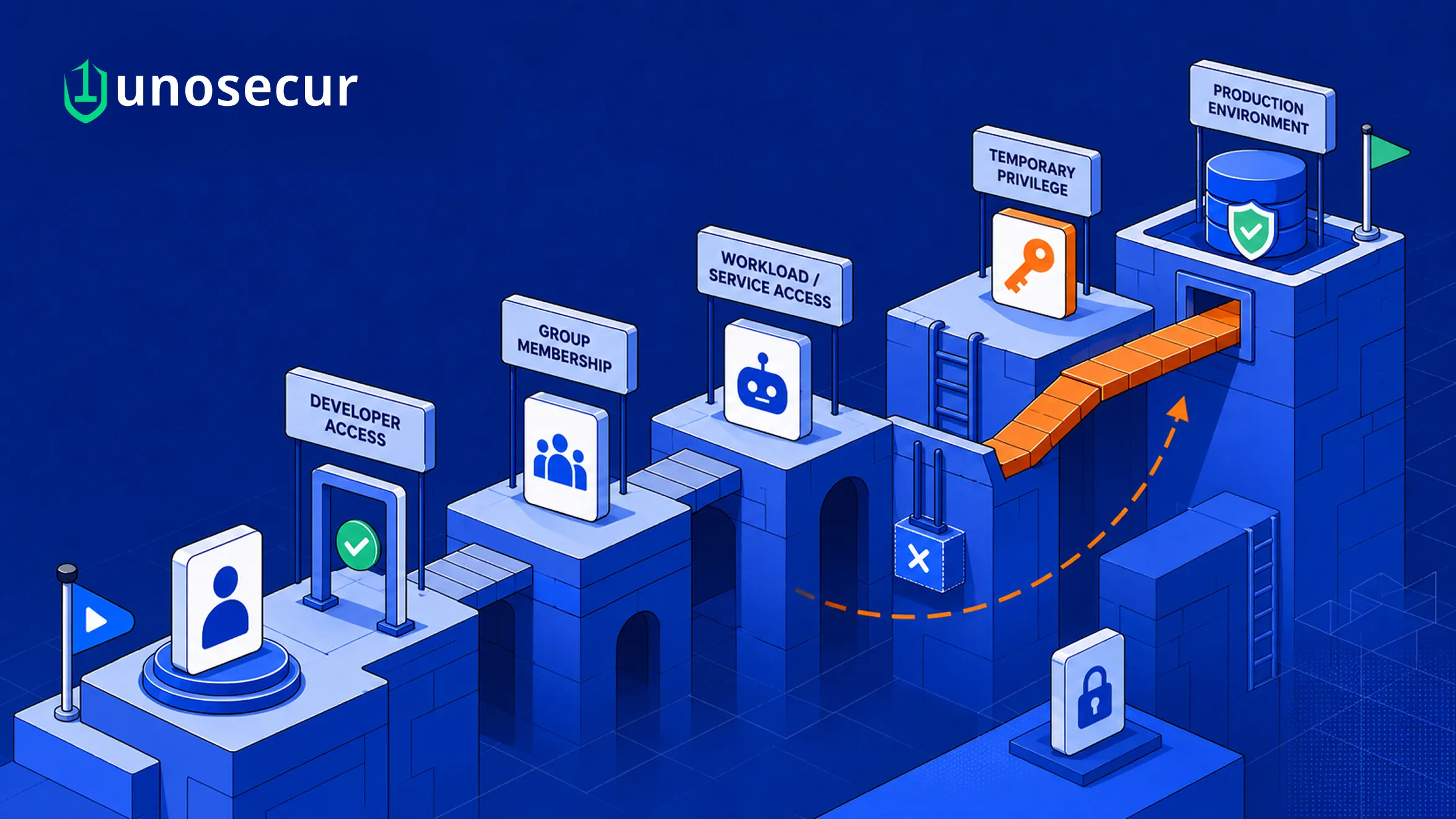
Some of the most dangerous identity risks do not begin with an attacker. They begin with an administrator granting temporary access. A developer changes teams but keeps an old role. A service account receives broad permissions because nobody knows exactly what it needs. An OAuth application gets a scope that is never reviewed again. Everything works. Nobody gets an alert.
That is exactly why identity system misconfigurations are difficult to manage. They can sit quietly inside legitimate access until someone compromises the identity that holds them. Palo Alto Networks Unit 42 reported in its 2026 Global Incident Response Report that identity weaknesses played a material role in nearly 90% of the incidents it investigated. Its research also found identity-based techniques accounted for 65% of initial access.
This does not mean misconfiguration caused every incident. It shows why the permissions behind an identity matter so much once that identity enters an attack chain. A stolen credential gives an attacker an identity. Your access configuration determines what they can do with it.
The problem starts with the gap between intended and actual access.
An IAM misconfiguration occurs when an identity can perform an action your security model did not intend. That sounds straightforward. In practice, the difference can be difficult to see. A user might have one role through their department, another through a project group, and temporary cloud permissions granted during an incident. A service account could inherit access through several policies. A workload might be allowed to assume another role that holds much broader privileges.
Each configuration can appear legitimate on its own. Together, they can create gaps in access control.
This is the difference between assigned access and effective access. Assigned access shows which roles and permissions are assigned to users. Effective access indicates what the identity can ultimately access.
Attackers care about the second.
How can legitimate permissions quietly become dangerous?
Most IAM misconfigurations are not caused by a single catastrophic mistake. Access changes gradually as people, applications, and infrastructure change.
Temporary privilege survives its expiration date.
A developer needs production access during an incident. An administrator grants it. The problem gets fixed, but the permission stays. Nothing appears broken, so removing it becomes a low-priority task. The result is standing excessive permissions. Months later, compromising that developer account also means compromising access that should have disappeared long ago.
Role changes leave old access behind.
Internal movement creates another common problem. A cloud engineer moves into security. Their new permissions take effect immediately, but nobody removes all entitlements associated with the previous job. Repeat that across several role changes and privilege creep develops. The individual access requests were legitimate. The resulting combination may no longer be.
Non-human identities become invisible administrators.
Service accounts, service principals, workloads, OAuth applications, API credentials, and AI agents can hold substantial privileges. These identities often receive broad access because tightening their permissions risks breaking an application or automation workflow. Ownership can also become unclear. The engineer who created an account leaves, but the identity and credentials remain active. The organization now has a powerful identity that few people understand, and nobody regularly reviews.
Trust creates indirect paths to privilege.
Some of the most serious cloud IAM errors do not directly grant administrator access. Instead, they create a path to it. An identity can modify a role. Another permission lets it pass that role to a service. The service can retrieve a secret belonging to a more privileged workload. No single permission says "administrator." The combination creates the escalation path. This is why reviewing individual policies often fails to reveal the real exposure.
What happens when an attacker inherits the wrong identity?
Consider two compromised developer accounts. The first can access source code and a development environment. The second appears similar but has an old production role, permission to assume a service role, and access to a secrets store. Both incidents begin with a compromised developer identity. They do not end the same way.
The second attacker may be able to reach production without exploiting another vulnerability. The access path already exists. That is the security impact of misconfigurations in identity systems. They increase the blast radius of another security failure. A dormant administrator account matters because of what it can access, and a wildcard policy matters because of what actions it permits. An unsafe trust relationship matters because of where it can lead.
The most useful IAM misconfiguration examples are therefore not simply lists of bad settings. They are configurations that create meaningful attack paths.
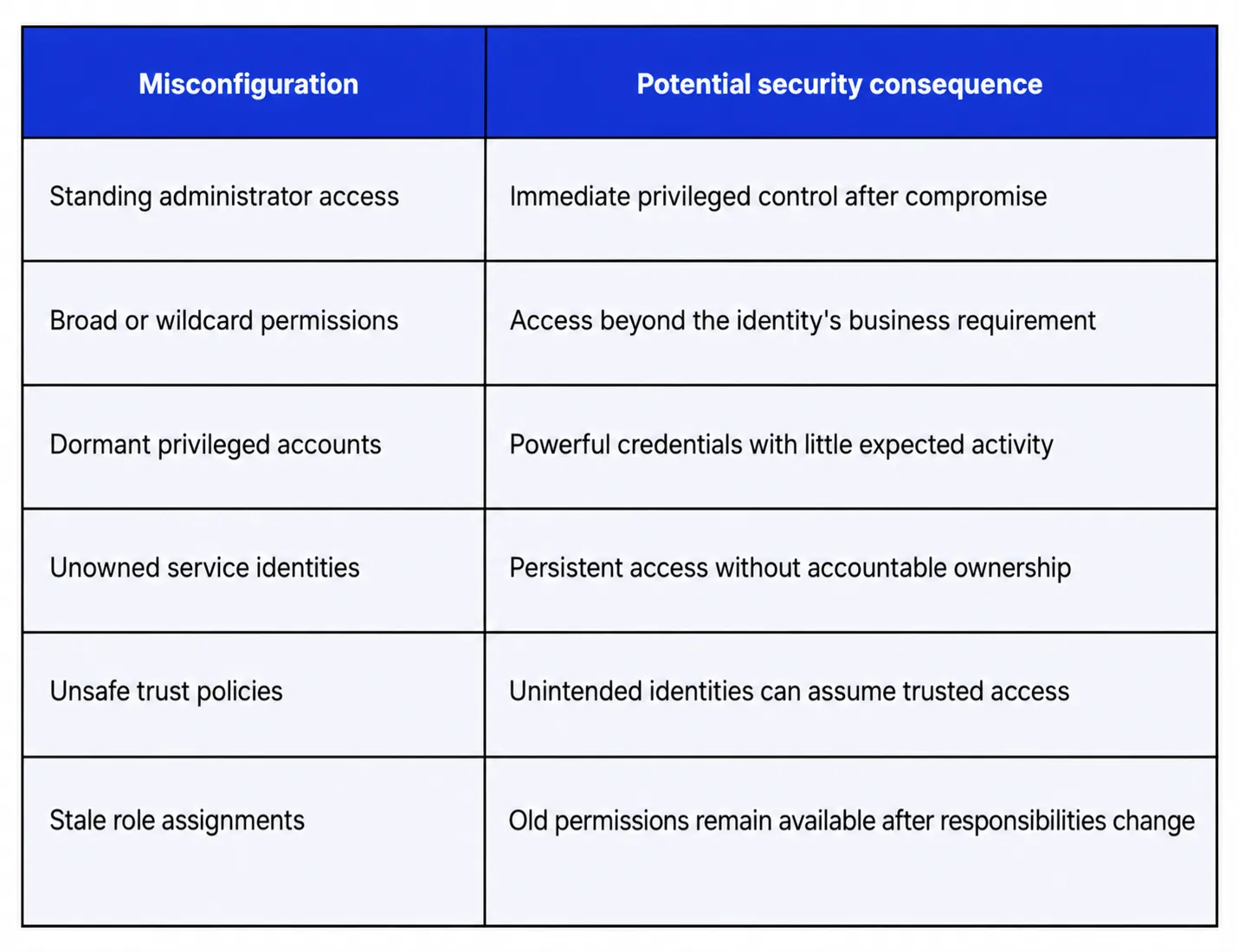
The common factor is reach. Each configuration changes what a compromised identity can potentially do next.
Why do these access paths stay hidden?
If these configurations are so dangerous, why do they remain? Because traditional IAM administration often shows permissions as objects rather than paths. A console can tell you that a user belongs to a group. Another can show the group's role. A cloud platform can show the role policy. A separate system records the workload that role can access. The attack path exists across all of them. This creates a visibility problem for identity security posture.
Security teams need to connect human identities, non-human identities, groups, roles, entitlements, resource policies, credentials, and trust relationships. They also need to understand how those relationships change over time. Periodic access reviews help, but they capture a point in time. Between reviews, employees move teams. Workloads appear. Cloud policies change. Temporary privileges get created. SaaS integrations receive new scopes.
A quarterly spreadsheet can show yesterday's assignments. It cannot tell you that a new privilege path appeared this morning.
Find dangerous access before an attacker does
Reducing misconfiguration risk starts by changing the question. Do not ask only, "What permissions does this identity have?"
Ask:
- What sensitive resources can this identity ultimately reach?
- Which permissions could increase its privilege?
- Which access is no longer being used?
- Which identities have persistent privileged access?
- Which trust relationships connect separate environments?
- Who owns each privileged human and non-human identity?
These questions make least privilege measurable. If an identity has 50 permissions but regularly uses only 6, the remaining permissions warrant investigation. If a workload suddenly receives a new production route, that change warrants attention before the next quarterly review. This is also where continuous identity visibility becomes more useful than periodic cleanup.
Move from IAM configuration to identity security posture.
You cannot prevent every access mistake in a changing environment. You can make those mistakes easier to find and harder to leave untouched. Unosecur's Unified Identity Fabric helps organizations discover human, non-human, and AI identities across cloud environments, SaaS platforms, identity providers, and connected systems. Teams can map identity relationships, understand effective access, identify excessive privilege, and investigate risky paths before they become useful to an attacker.
That changes IAM from a collection of configuration screens into a security question: If this identity were compromised right now, where could it go? If you cannot answer that question, you do not fully know your identity security posture. And that is what makes identity misconfiguration dangerous. The setting itself may be quiet. The access path behind it is what matters.




%201.svg)



.webp)

.avif)