.avif)





%201.svg)
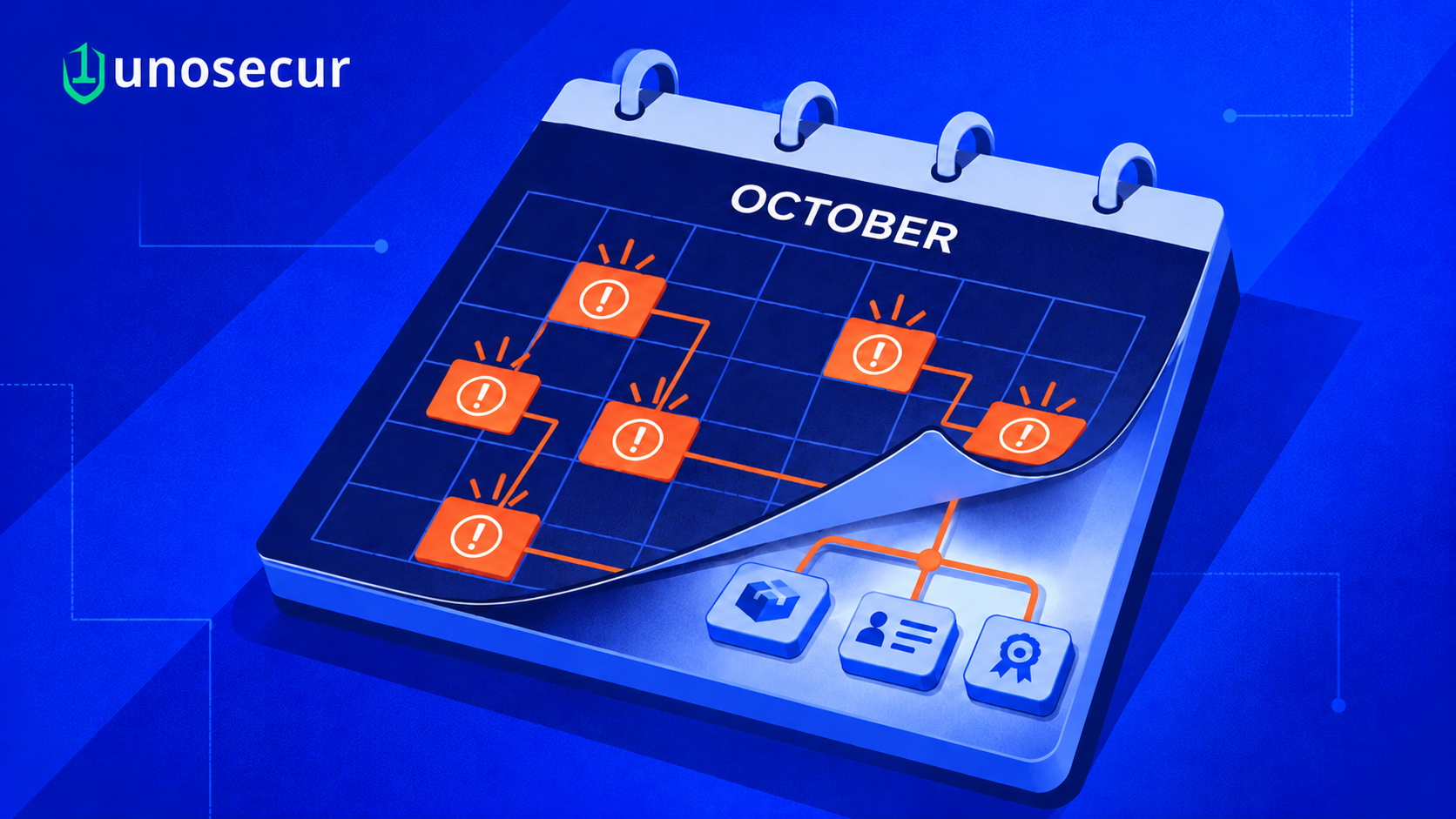
Prioritized alerts, powered by MITRE framework
Prioritization of alerts based on MITRE ATT&CK framework intelligence from Unosecur Labs that reduces alert fatigue and false positives.
Instead of drowning in thousands of generic alerts, security teams see threats mapped to actual adversary tactics and techniques. Each alert includes MITRE ATT&CK context, blast radius analysis, & recommended containment actions. Your SOC focuses on real identity-based attacks, not noise.
Contextualized remediation
Contextualized threat alerts based on your environment and systems, improving the speed and precision of incident response.
Remediation playbooks adapt to your specific cloud environment, identity provider setup, and compliance requirements. When a compromised service account is detected, you get step-by-step guidance tailored to your AWS, Azure, or GCP configuration.
Enhanced privilege tracking
Monitoring of privilege escalation attempts and identity attack paths helps identify privilege misuse in real-time and escalations.
The system continuously maps privilege escalation paths across your identity graph. If an attacker tries to move from a low-privilege account to admin access, the escalation attempt triggers immediate alerts with full context: which identity, what path they're taking, and which critical resources are at risk.


Everything you Need to Know

They build a single identity graph spanning cloud, SaaS, on-prem, and AI agent activity. Behavioural baselines run per identity rather than per system, so a privilege chain that escalates across AWS and Salesforce is detectable as one event. Correlation against threat intelligence and known attack patterns enriches the signal. Cross-environment detection requires normalised telemetry, which siloed tools cannot produce.
Shift from scheduled scans to runtime telemetry. Correlate identity events across every connected system in a single graph, so privilege chains and anomalies surface as one detection rather than scattered alerts. Pre-built playbooks for common attack patterns shorten investigation. Behavioural baselining cuts false positive volume, which is what usually drags detection time. The bottleneck is rarely the alert. It is triage.
Impossible travel between logins, sudden privilege escalation, MFA fatigue patterns, OAuth grants to unknown apps, dormant accounts coming alive, AI agents calling tools outside their scope, service account credentials used from unusual networks, and bulk permission changes outside change windows. Single signals are noisy. Correlated patterns across identity, network, and endpoint telemetry produce reliable detections.
Track identity assumption chains: who assumed which role, used which token, accessed which resource, and pivoted to which downstream system. Lateral movement leaves a graph trace even when individual hops look legitimate. Behavioural baselines flag identities suddenly accessing systems outside their pattern. AI agents and service accounts are common pivot points, since their broad scopes make movement easier than for a human user.
Pull last-activity timestamps from every connected system and overlay them with permission scope. Identities unused for 30, 60, or 90 days become candidates for revocation, weighted by the privilege they hold. Stale admin accounts and dormant AI agent credentials carry the most risk. Continuous monitoring catches identities that go dormant after the initial cleanup, which is where most teams lose ground.
AI does two useful things. It builds behavioural baselines that no analyst could maintain manually across thousands of identities, so anomalies surface without static rules. And it exposes the identity graph through natural language, so investigation and reporting work without writing queries. Anything else marketed as AI in this space is usually pattern matching against a small ruleset.
A category covering detection of identity-driven attacks (credential theft, privilege escalation, OAuth abuse, AI agent compromise) and automated response (revoke access, rotate credentials, disable accounts, suspend agents). It assumes identity is the primary attack surface and that endpoint or network detection misses identity-only paths. Unosecur extends the model to AI agents and NHIs, which most tools in the space overlook.


%201.svg)




.webp)

.avif)
.webp)