
.avif)






%201.svg)

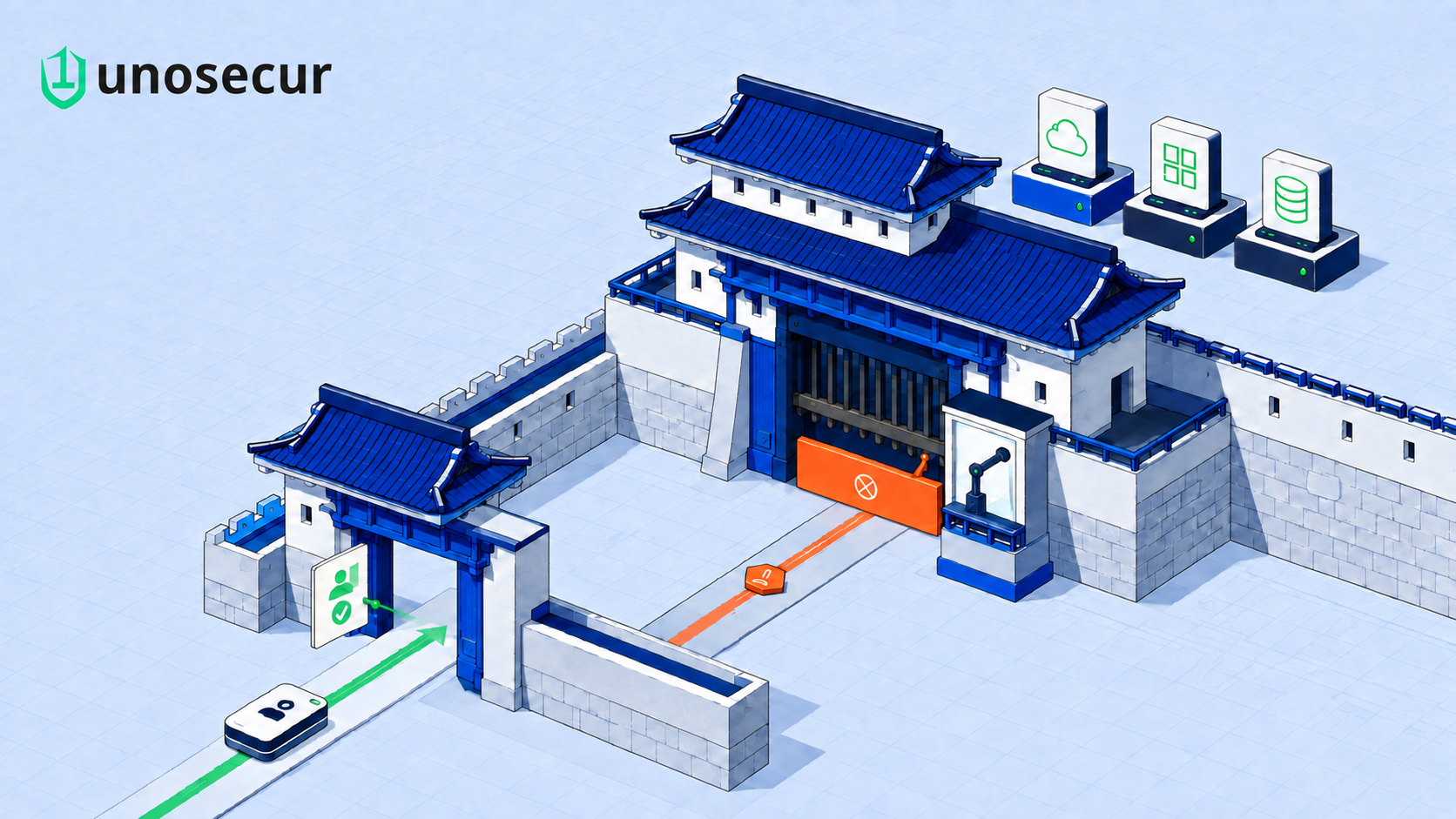
Vendors in both categories now use nearly identical language. Risk scoring, policy enforcement, audit trails, and oversight dashboards appear on the homepage of an AI agent security platform and an AI governance platform alike. The overlap in messaging hides a real difference in what each system controls. An agent governance platform generally answers whether an agent should exist, who approved it, and whether its use complies with internal or regulatory policy. A dedicated AI agent security platform answers what an agent can actually do right now, and whether that authority can be revoked before it causes damage.
Confusing the two leaves a gap: an organization can be fully compliant on paper while an agent still holds unmonitored, unrevoked access in production. The six distinctions below show where each category's control genuinely stops, and where the broader category of AI security tools picks up what governance alone cannot enforce.
1. Approval workflow vs runtime authority
An AI governance platform tracks whether an agent was reviewed, approved, and documented before deployment. An AI agent security platform tracks what that agent can reach after deployment, independent of what was approved on paper.
Evaluation test: Ask the vendor to show an agent's current effective permissions, not its original approval record. Governance tools typically stop at the record; security platforms should show the live permission set.
2. Policy documentation vs policy enforcement
Agent governance platform deployments tend to store acceptable-use policies, model cards, and risk classifications, an approach closely related to traditional identity governance and administration programs extended to AI. Few of them can stop an agent from violating a policy in real time. An AI agent security platform enforces access- and action-level policy at the point an agent attempts something, using deterministic controls rather than documented intent.
Evaluation test: Write a policy prohibiting a specific action, then have an agent attempt it. A governance platform logs the violation after the fact; a security platform should block it.
3. Model-level risk vs identity-level exposure
Governance tools typically assess risk at the model or use-case level: is this model appropriate for this task, and does it meet a fairness or compliance threshold? An AI agent security platform assesses risk at the identity level: what credentials, tools, and downstream systems does this specific agent instance currently hold?
Evaluation test: Ask each platform to explain the blast radius of one production agent. A governance answer will describe the model's approved scope. A security answer should describe actual reachable resources.
4. Static registration vs continuous discovery
An agent governance platform usually relies on agents being registered through an intake process. An AI agent security platform should continuously discover agents across cloud, SaaS, and development environments regardless of whether they were formally registered.
Evaluation test: Deploy an agent outside the normal intake process and measure how long each platform takes to notice it.
5. Compliance reporting vs forensic reconstruction
Both categories produce audit trails, but for different purposes. AI governance platform audit trails typically demonstrate that a review process was followed, often built around continuous evaluation rather than periodic checkpoints, a shift covered in more depth in our governance strategies for machine and AI identities. Security audit trails, by contrast, need to reconstruct identity, permissions, tool calls, and policy decisions behind a specific action for an incident investigation.
Evaluation test: Pick one sensitive action from last week and ask each platform to explain not just that it happened, but under whose authority and which control allowed it.
6. Oversight committee vs containment action
An AI governance platform routes flagged agents to a review committee. An AI agent security platform, or the broader set of AI security tools it sits alongside, should be able to suspend the agent, revoke its tokens, and terminate its sessions directly, without waiting on a committee cycle.
Evaluation test: Trigger a high-confidence risk scenario and time how many steps and how many people it takes before the agent actually stops acting.
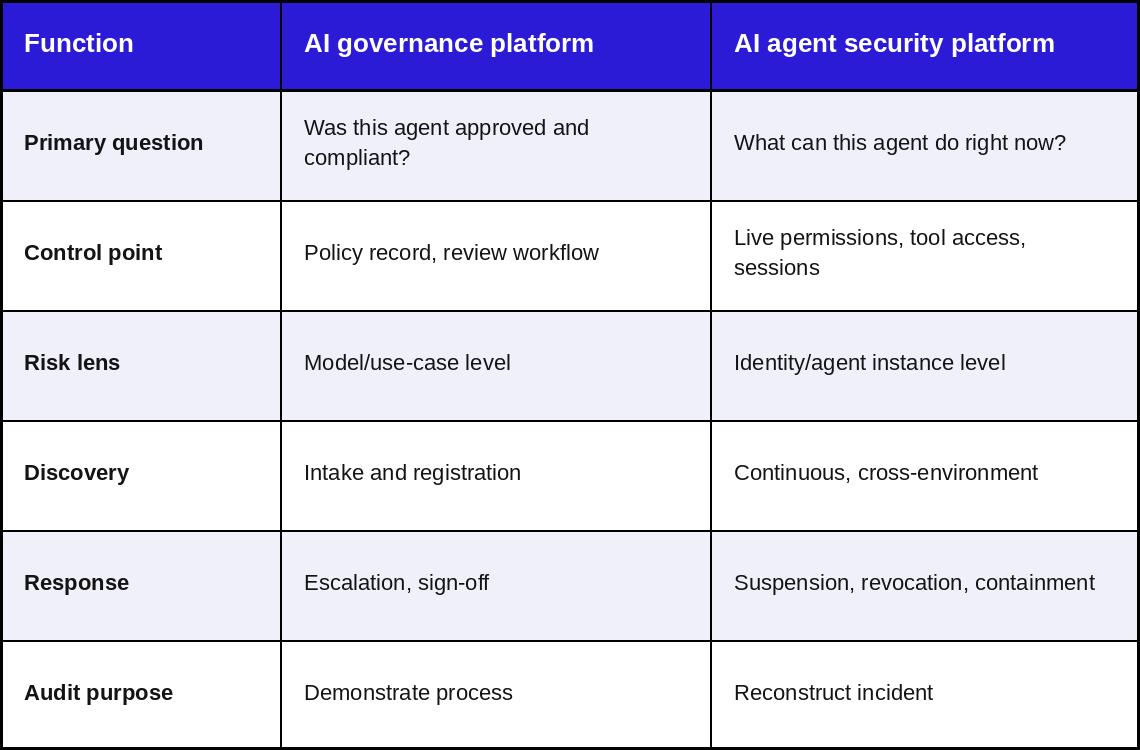
Most enterprises need both. The mistake is buying an agent governance platform and assuming it covers runtime enforcement or expecting a security platform to run approval workflows it was never built to manage.
Where does Unosecur fit into this evaluation?
Unosecur's AI agent security platform is built for the runtime side of this problem, not the governance layer, and that distinction shapes what it controls. Its Unified Identity Fabric treats each agent as a distinct identity, correlating credentials, permissions, tools, and behavior across cloud, SaaS, identity-provider, and on-premises environments through more than 100 integrations.
Rather than tracking whether an agent was approved, Unosecur surfaces what it can currently reach: effective permissions, accessible resources, and behavioral risk, updated continuously rather than at intake. Its access-governance layer supports activity-based right-sizing and just-in-time access, and its MCP gateway extends the same identity model to the agent-to-tool boundary, covering authentication, authorization, and session control.
For organizations that already run an agent governance platform for approvals and policy documentation, Unosecur is the layer that answers what happens after approval, when the agent is live. Its authority needs to be monitored, right-sized, and revoked if necessary.



.png)
.png)
%201.svg)


.webp)

.avif)