.avif)





%201.svg)


.png)
A vulnerability in a file-sharing system allowed a small number of unauthorized users to read unencrypted personal data from about 3.05 million people in the Pentagon data breach in 2026. This US military data breach ran from October 2025 until July 16, 2026, when the Defense Manpower Data Center (DMDC) discovered the vulnerability during a wider defense department cyber breach investigation and patched it.
The vulnerability is the smaller story. The larger one, and the one you'll recognize from your own estate, is what sat behind it in plaintext and how long the access lasted.
What did the breach letter and the Pentagon's numbers confirm about the DMDC data breach?
DMDC maintains records for more than 60 million military and civilian personnel, contractors, family members, retirees, and veterans. Military Times reviewed a breach notification that DMDC sent on September 18 to affected individuals, and two defense officials confirmed the letter is authentic. The timeline below comes from that letter and from what Pentagon officials later told ABC News and Federal News Network.
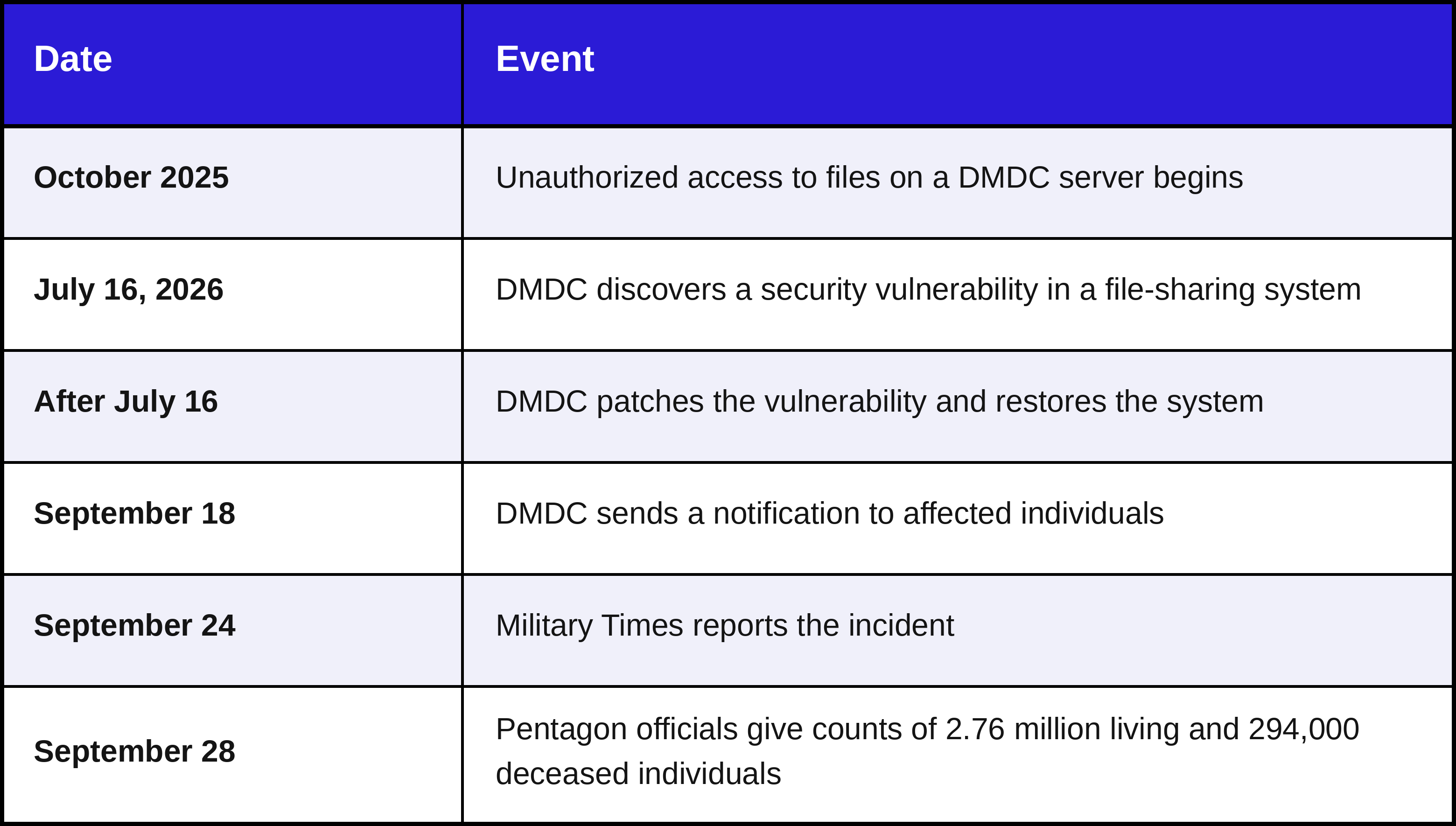
The scale of the Pentagon data breach wasn't clear to anyone at first. Military Times reported that about 4 million people may be affected, citing two people familiar with the incident, but no one had confirmed that figure.
A U.S. defense official then gave ABC News the figures: 2.76 million living and 294,000 deceased, for a total of about 3.05 million. Federal News Network reported nearly 2.8 million living and the same count of deceased.
Each affected record included a Social Security number plus at least one other identifier, such as name, date of birth, contact information, sex, race, or military occupational specialty. Military data exposed in the files could raise national security concerns. A Social Security number never expires, and a record that ties a named person to a military occupation adds a second layer of PII exposure on top of the fraud risk.
Why did a single vulnerable server expose 3.05 million people in this Pentagon cyberattack?
The confirmed facts describe two separate failures. A vulnerability existed in a file-sharing system, and the server behind it stored unencrypted personal information. The second failure is what turned the first into an incident affecting 3.05 million people.
Patch the first, and you've fixed a bug. Leave the second, and your next vulnerability inherits the same reach.
The Pentagon official who spoke to Federal News Network declined to answer several questions regarding this US military data breach, including who accessed the data, whether the access was intentional, and why personal information was stored on an unencrypted server. The reporting doesn't say how the data reached that server, who could read it, or why it stayed there. It also says nothing about the rest of DMDC's storage, so the claim is limited to the files on this server.
The patch closed the vulnerability, but it hasn't been reported whether the plaintext was moved, encrypted, or deleted afterward.
What hasn't anyone disclosed about the product, the CVE, or the attacker?
If you're looking for technical detail, the public record is thin. DMDC hasn't named the file-sharing product or a CVE, and no group has claimed responsibility. The Pentagon says there's no indication of misuse, and that reflects what it has observed so far. Whether data left the server is a separate question the reporting doesn't answer.
The Pentagon's wording is "a small number of unauthorized users." That fits an outside exploit, but it also fits an access-control flaw that lets people with valid accounts open files they weren't entitled to. The reporting doesn't say which.
You should read the window with the same care. The access period for this DMDC data breach runs from October 2025 to July 16, 2026, and it doesn't show a continuous foothold for nine months. Federal News Network calls it nearly a year, while the letter's dates span up to about 9.5 months. Espionage is an obvious risk for this dataset, and no one has provided evidence that it occurred.
What set the blast radius?
How the users got in didn't determine the size of this incident; what the server held did. Every file on it sat inside the blast radius from the day the vulnerability existed.
The reporting doesn't say whether credentials, service accounts, or tokens were involved. If the vulnerability alone granted access, the server's contents set the blast radius. If credentials were involved, what those credentials could reach set it. Either way, the design built in the exposure long before anyone found it.
Which of those two cases would your team be able to rule out today?
Put your own estate in the same frame. If one of your file shares held regulated data in plaintext for nine months following a Pentagon cybersecurity breach, would you know? Who on your team would notice the reads? You'll find out when an auditor or an attacker does.
What should you check on every file-sharing server you run?
The patch is done, so the useful work now sits with the conditions the incident exposed. Each check holds up for your estate, whatever the reporting eventually reveals about the vulnerability.
- Inventory every file-sharing and file-transfer server you run, and list what each one stores and which of its data is regulated.
- Scan those shares for Social Security number patterns and other PII, then delete what has no current purpose and encrypt the rest.
- Encrypt sensitive files at the file level with keys held outside the file-sharing service, so access to the server alone doesn't yield readable content.
- List every identity that can read each share, including the application's own service account, other service accounts, API tokens, and OAuth grants, and remove standing access that no current process needs.
- Log file reads on your shares and alert when an identity reads sensitive files it never touched before, or reads far above its baseline.
- Set retention on your shares so files are removed once the transfer is complete, and check that your retention jobs still run.
- After you patch an internet-facing system, review access logs back to the earliest date the vulnerability could have existed, rather than starting from the date you found it.
Which identities could reach the server holding 3.05 million people's data?
The reporting leaves open whether credentials played any part. Either way, the first question after discovery is which identities could reach that server. Without a clear answer, no one can say where it stops.
That answer has to be in place before the breach letter goes out, and that's the work Unosecur does. It shows you every AI agent, non-human identity, and human user across your connected systems that can reach a server like this one, and what each of them can do there.
Put Unosecur against a server like DMDC's. A file share containing regulated data on millions of people would show up with the identities that can read it, including service accounts nobody remembers granting access to. Excess privileges and stale access on that share would surface as findings with clear fixes, so your team can remove them before an attacker uses them.
Unosecur also helps limit the impact of the next vulnerability. When fewer identities have standing access to sensitive files, an exploit on that server inherits less access. When access to a sensitive server changes, you see it in that identity's record rather than in a vulnerability report. If an identity starts behaving outside its baseline, Unosecur flags it and can help you quarantine it while your team investigates.
When a regulator asks who held access, you won't be stuck in weeks of log digging. With Unosecur, you'll hand over an answer that already exists.
If you want a start tomorrow, ask your team three things.
- Which identities, human and non-human, can read our file-sharing servers today?
- Would we notice if one of them read ten times its normal volume?
- What regulated data sits on those servers in plaintext, after its purpose has been served?



.webp)

%201.svg)




.webp)

.avif)
.webp)