.avif)





%201.svg)

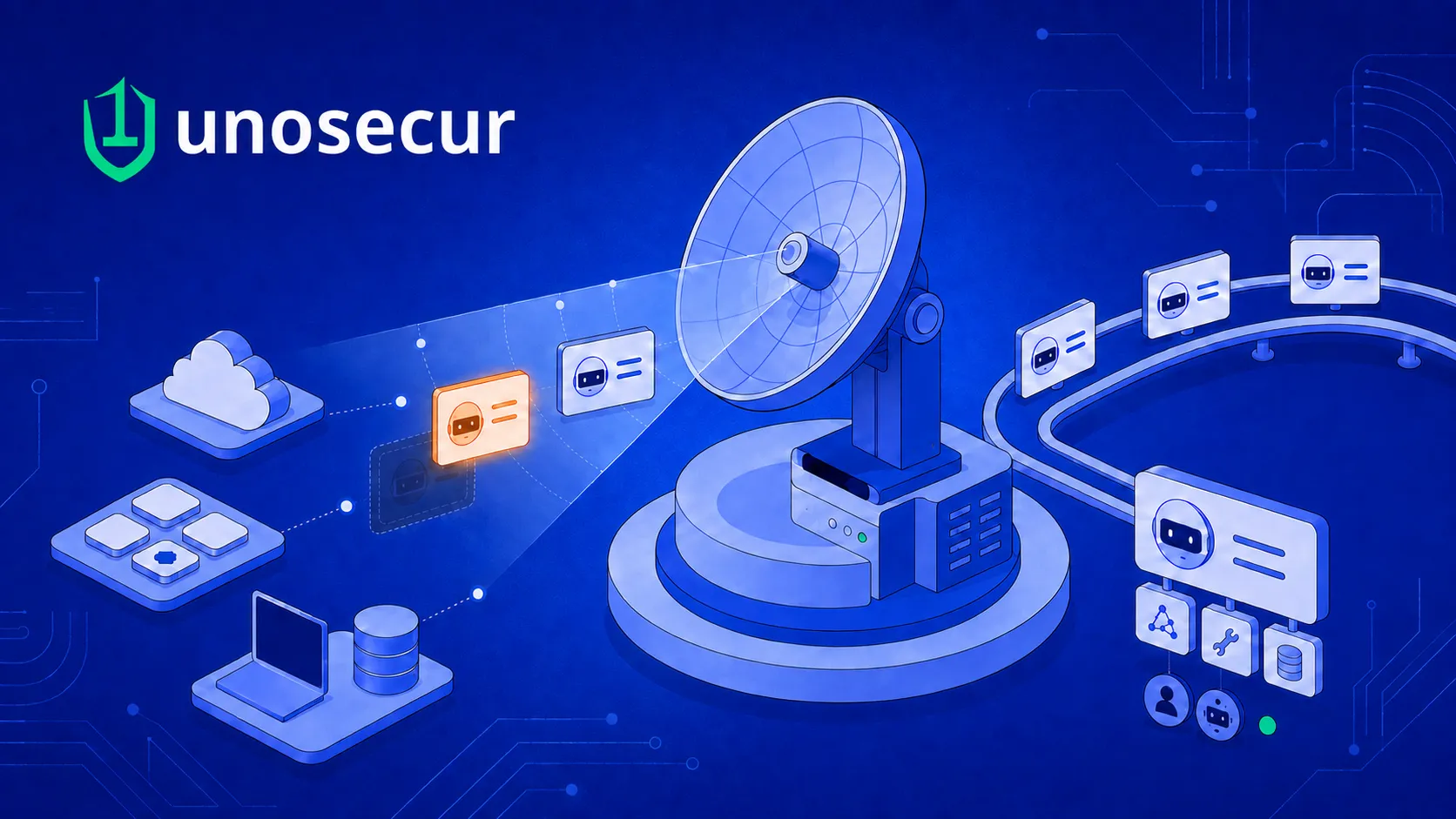
Most security teams can tell you how many employees they have. Far fewer can tell you how many AI agents are running in their environment right now. That gap is not a reporting problem. It is a visibility problem. Agents get spun up inside a SaaS platform, connected to a cloud project, or built by a developer testing an automation idea, and none of it passes through the provisioning process a human identity would.
By the time security notices, the agent has already been granted a credential, connected a tool, and started acting. AI agent discovery exists to close that gap before it becomes an incident.
The problem with counting agents after the fact
Traditional identity inventories were built around people and predictable service accounts. Agents do not fit that model. They multiply quickly, they get created outside standard workflows, and they often inherit access from the platforms and tools they connect to rather than from a single, clean grant.
An enterprise that relies on manual registration or periodic audits is effectively asking teams to self-report. Some will. Many will not, not out of negligence, but because agents are usually built to solve a problem quickly, not to satisfy a security checklist.
Why do shadow agents form?
The result is a category of shadow AI agents: active, credentialed, and invisible to the teams responsible for governing them. A contractor connects an agent to test a workflow. A developer wires one into a repository over a weekend. A business team adopts a SaaS feature that quietly deploys its own agent behind the scenes. None of these get flagged in a normal provisioning queue, so none of them appear in a normal inventory.
You can read more about why this has become the fastest-growing identity risk in enterprise cloud environments in our earlier breakdown of how most organizations miss it entirely.
What continuous discovery actually means?
The Discover Agents capability is built to remove the dependency on manual enrollment. Instead of waiting for a team to register an agent, discovery runs continuously across cloud providers, SaaS applications, and development environments, surfacing agents as soon as they appear.
Discovery as a signal, not a one-time event
An agent doesn't announce itself once. It reappears every time it authenticates, calls a tool, or touches a new resource. Continuous discovery treats each of those moments as a signal worth capturing, rather than something to be caught during a quarterly review.
The practical outcome is simple. An agent that a developer connects on a Tuesday afternoon, outside any formal provisioning process, should be visible in the inventory before the end of that session, not discovered three months later during an audit.
One view, not four separate ones
Discovery alone is only half the value. An agent inventory that lives in its own dashboard, separate from human and non-human identity data, still leaves security teams doing manual correlation to answer a basic question: does this agent's access make sense next to everything else in the environment?
That's why agents are surfaced alongside human identities and other non-human identities in a single unified view, rather than as an isolated category. Seeing an agent's identity next to the service accounts, human users, and machine identities it interacts with is what turns an inventory into something a security team can actually act on. This is the same principle behind Unified Identity Fabric, which correlates identities across environments so nothing gets evaluated in a silo.
What's behind the agent matters as much as the agent itself?
An agent's identity card is incomplete without the layers underneath it. Two agents can look identical from the outside, but one is connected to a sensitive knowledge base and a handful of read-only tools. At the same time, the other has access to a general-purpose model and a tool that can write to production systems.
Visibility into the models, tools, and knowledge bases behind each agent is what separates a name-and-status inventory from a genuinely useful one. Security teams need to see which model an agent runs on, which tools it can invoke, and which knowledge base or data source feeds its context, because that combination is what actually determines what the agent can do, not the label attached to it.
This context also feeds directly into what happens after discovery. An agent's exposure changes across its lifecycle, from the moment it's provisioned to the day it's retired, which is exactly why lifecycle governance needs to build on this same inventory. Our guide to agent lifecycle security, from provisioning to decommissioning, walks through what that continuity should look like in practice.
Where does Unosecur fit?
Discover Agents is part of how Unosecur approaches AI agent security at the identity layer. Agents are continuously found across cloud and SaaS environments and placed into the same unified view as human and non-human identities, with the underlying models, tools, and knowledge bases mapped alongside each one. For a closer look at how this fits into the broader platform, our AI Agent Dashboard gives full visibility into every agent operating in your environment.
The question worth asking isn't whether your organization has AI agents. It almost certainly does. The real question is whether your security team can currently see all of them, and what's connected behind each one.
See what's hiding in your environment. Book a demo.




%201.svg)




.webp)

.avif)
.webp)