
.avif)





%201.svg)
.webp)
%20(1).webp)
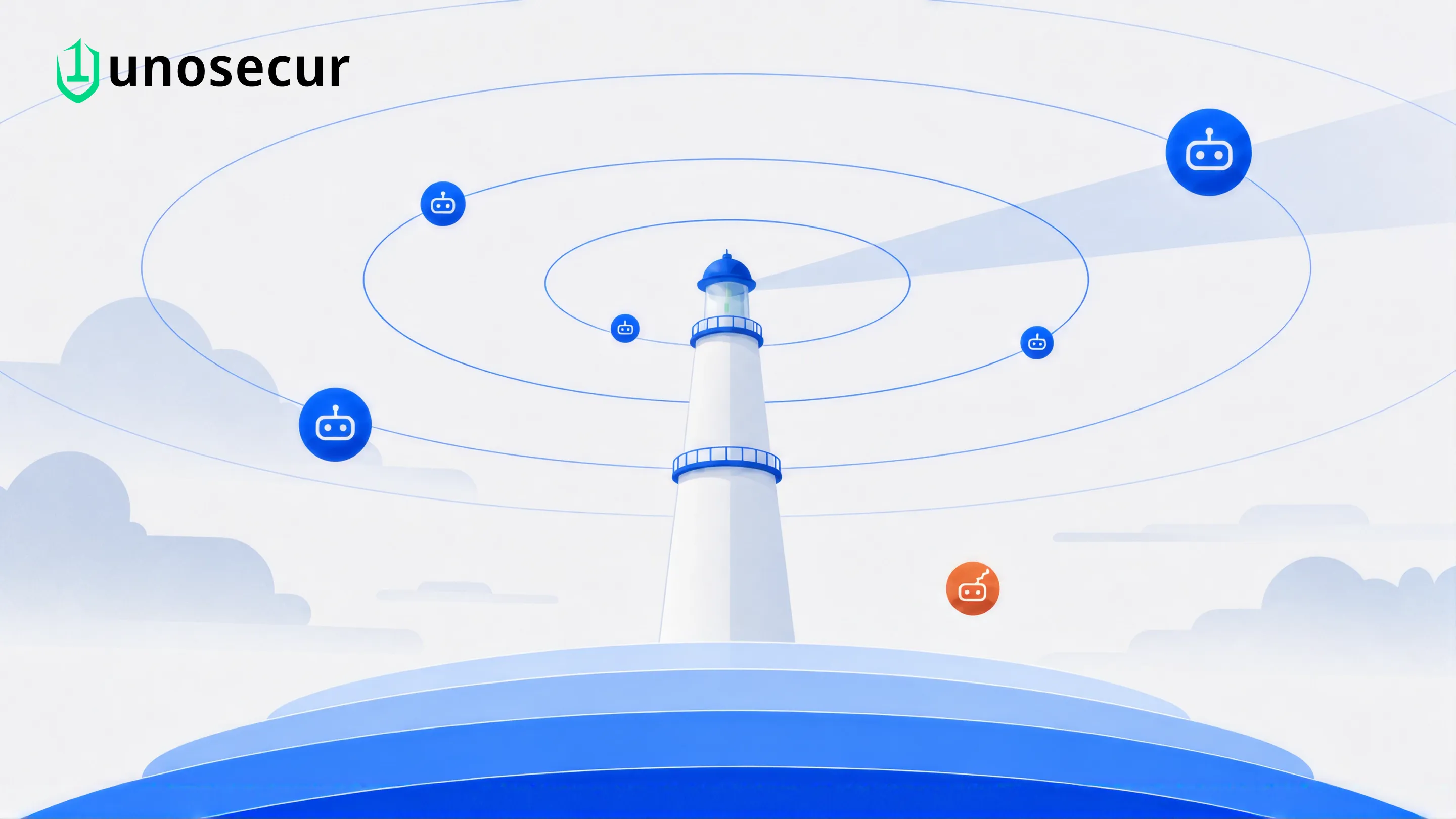
Every major technology shift creates a new form of technical debt. The cloud gave us infrastructure debt. SaaS adoption saddled us with application debt. As modern networks dissolved, identity fragmented into an unmanaged ocean of service accounts, API keys, and machine credentials. Now, as enterprises rapidly move from simple chatbots to autonomous AI agents, a new engineering challenge is quietly emerging, one that is best understood as AI Permission Debt.
It is not a traditional vulnerability, nor is it a simple human misconfiguration. AI Permission Debt is the gradual, compounding accumulation of autonomous identities, wide-open scopes, tool integrations, and trust relationships that become impossible to reason about as AI adoption scales.
AI adoption is no longer the challenge
A year ago, most engineering teams were experimenting with single-purpose LLM integrations. Today, organizations are deploying complex agentic networks: coding assistants that auto-remediate repositories; support agents updating production data, and workflow automation agents bridging core cloud infrastructure.
To be genuinely useful, an agent cannot sit in a sandbox. It needs real, active access to enterprise systems:
- GitHub repositories and Jira boards
- Communication fabrics like Slack and Google Workspace
- Core business databases and production cloud platforms
The more autonomous an agent becomes, the more permissions it requires. And that is exactly where the debt begins to collect.
The anatomy of AI permission debt
Nobody intentionally creates a messy codebase or an insecure environment. Technical debt accumulates through reasonable, fast-paced design decisions made to bypass immediate friction. AI Permission Debt follows the exact same pattern.
Imagine a developer building a project tracking agent. Initially, it is granted access to GitHub to analyze pull requests. To close loop intervals, it is given Jira access to update tickets. It then needs Slack permissions to alert the team, followed by database access to pull operational metrics, and finally, a few Model Context Protocol (MCP) server connections to pull local developer tools. Individually, every single credential grant is logical. But months down the line, the engineering context dissolves. Teams are left facing critical structural unknowns:
- Does this specific agent still need active write access to that production schema?
- Who actually owns this agent's orchestration lifecycle?
- Which third-party or open-source MCP servers is it actively executing code from?
- What happens to our underlying data layer if one of these long-lived API tokens is leaked?
This growing divergence between the access you granted to an agent and the access you actually understand and monitor is your permission debt.
The moving pieces: LLMs, clients, servers, and NHIs
To understand why this debt is so difficult to manage, we have to look at how modern enterprise AI architecture actually communicates. It isn’t just a single software loop; it is an ecosystem of shifting components that traditional security models were never built to handle.
The LLM and the agent (The client)
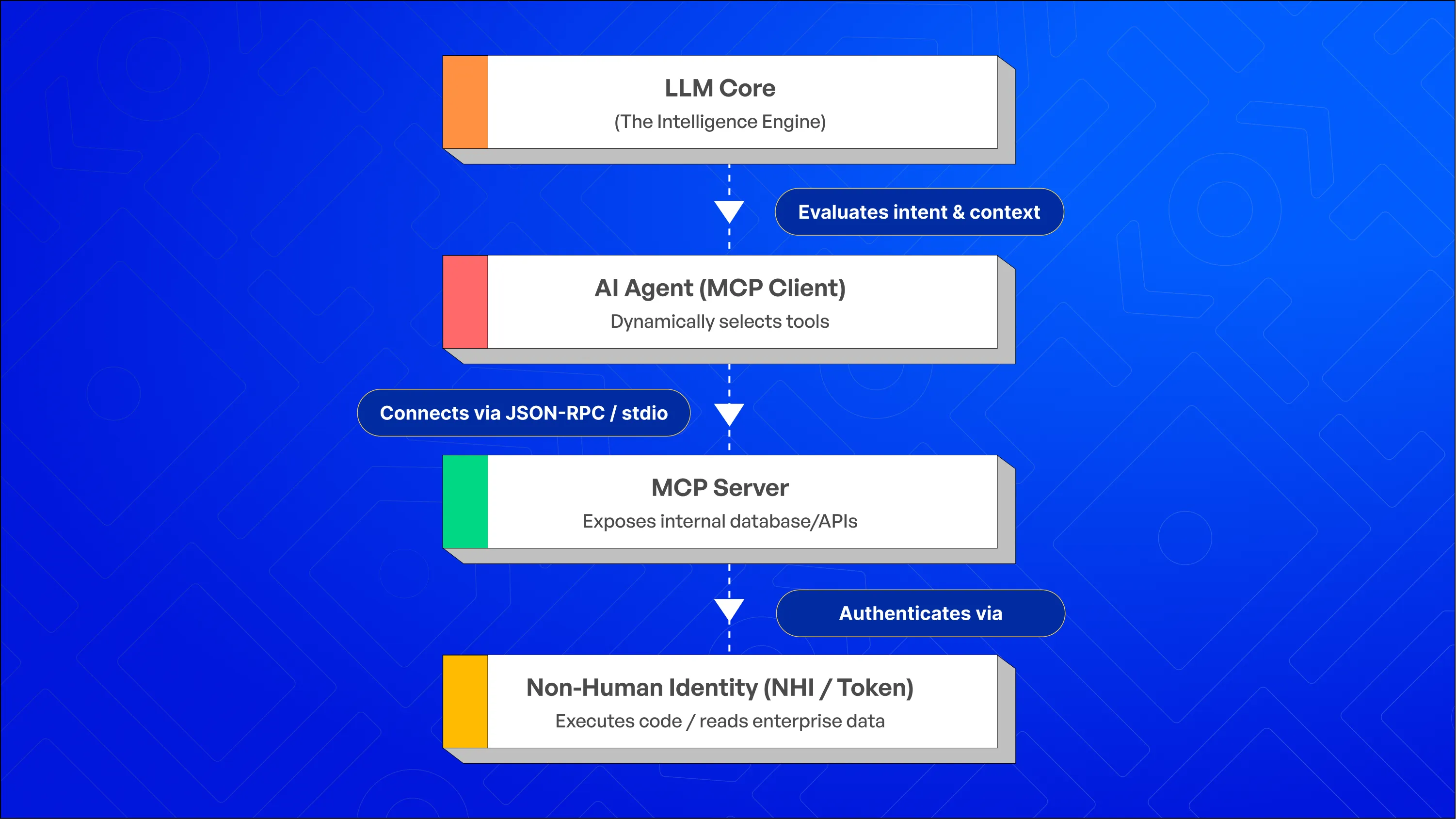
At the top sits the Large Language Model (LLM) - the reasoning engine. Wrapped around it is the AI Agent, acting as the MCP Client. Because the LLM is non-deterministic, the agent doesn't follow a hardcoded script. It reads user prompts, evaluates context, and dynamically decides which tools it needs to call on the fly.
The MCP server (The bridge)
To touch real data, the agent talks to an **MCP Server**. The Model Context Protocol (MCP) is the new industry-standard open bridge. It exposes your internal infrastructure—like a production Postgres database or an AWS environment—as a structured, discoverable interface that the agent can read and interact with.
The non-human identity (The key)
When an MCP server executes a command on behalf of an agent, it uses a Non-Human Identity (NHI) an API key, an OAuth token, or a service account credential.
This is where the architecture breaks traditional governance. The LLM can be manipulated via prompt injection into requesting an unexpected tool execution path. The MCP client obeys the instruction, the MCP server passes the request along, and if that underlying NHI carries wide-open wildcard permissions, the system executes the malicious command with full authority. Because engineers frequently use pre-configured, community-contributed MCP templates to save development time, maximum permissions are often accepted as an operational loan. When the testing ends, the code might be deleted, but the highly privileged NHI remains active inside your system leaving a silent layer of unmanaged architectural liability.
The technical capabilities required to pay down the debt
You cannot refactor AI permission debt using legacy spreadsheets, static IAM analyzers, or reactive vulnerability scanners. Managing this liability requires building core governance directly into your engineering and platform architecture through three essential capabilities:
Total visibility: the AI agent inventory
Before you can prune excessive privileges, you must establish an accurate machine registry. Organizations require continuous, real-time discovery capable of mapping every active autonomous agent, its engineering owner, the underlying machine identities it assumes, and the specific MCP servers it couples with. Without a single source of truth linking human responsibility to machine execution, lifecycle management is impossible.
Protocol separation: The MCP gateway
Because agent behavior is dynamic, access controls must be enforced at the protocol layer rather than solely at the application endpoint. An intelligent proxy or MCP Gateway must sit between your autonomous runtimes and enterprise APIs. By parsing, evaluating, and auditing JSON-RPC tool calls in real time, a gateway can detect anomalous semantic intent and terminate out-of-bounds requests before they ever hit downstream production infrastructure.
Standardized integration: The managed MCP marketplace
Platform teams must remove the friction that causes developers to take out permission loans in the first place. By providing an internal marketplace of pre-configured, sanitized, and cryptographically verified MCP server templates, engineers can securely connect LLMs to data layers using tightly bounded schemas by default.
How Unosecur helps: paying down the Debt
Like code debt, AI Permission Debt cannot be entirely avoided if you want to maintain engineering velocity. It is a natural byproduct of rapid innovation. The objective is not to stop building or to introduce heavy, bureaucratic compliance gates that stall developer productivity. The objective is to manage the loan. Managing this live ecosystem of non-human identities, MCP connections, and AI integrations requires a unified architecture. This is why we built Unosecur, a dedicated identity security platform engineered to help platform and security teams systematically eliminate AI Permission Debt without interrupting production velocity.
Unosecur integrates directly into your engineering and cloud stacks to tackle permission debt across four key operational areas:
Real-time AI agent inventory:
Unosecur continuously discovers and indexes every active AI agent, shadow machine identity, and developer integration across your ecosystem, establishing the single source of truth you need to track machine configurations.
Granular permission visibility & analysis:
We contextualize granted access against actual runtime behavior. Unosecur highlights exactly where your agents are over-privileged, mapping out their dependencies and identifying obsolete or stale keys that can be safely deleted.
Hardened MCP server marketplace:
To stop permission debt before it begins, Unosecur provides platform teams with a curated marketplace of pre-configured, secure enterprise MCP templates. Developers can immediately bridge LLMs to critical resources without defaulting to risky, wide-open community configurations.
The Unosecur MCP gateway:
Acting as a centralized control plane for your AI traffic, our gateway monitors, audits, and enforces security policies directly at the protocol layer. By intercepting non-deterministic JSON-RPC tool requests in real time, Unosecur ensures that no out-of-bounds commands can execute on downstream APIs.
Refactoring the architecture matrix
By transitioning from static identity management to dynamic, context-aware identity governance, engineering teams can ensure that as their AI workforce grows more autonomous and capable, the systems driving them remain visible, auditable, and fundamentally bounded.
Unosecur enables enterprises to aggressively deploy productive AI agents without losing control of their core architectural boundaries. Every permission granted to a machine today becomes a piece of the infrastructure we must understand tomorrow it's time to start refactoring the debt.
Key takeaway for your team
If you don't know the exact count of active API tokens, MCP servers, and service accounts running your AI integrations today, your architecture is running on uncollateralized permission debt. Step one isn't restricting developer velocity; it's establishing total visibility to pay down the debt.



%201.svg)

.webp)

.avif)