
.avif)






%201.svg)

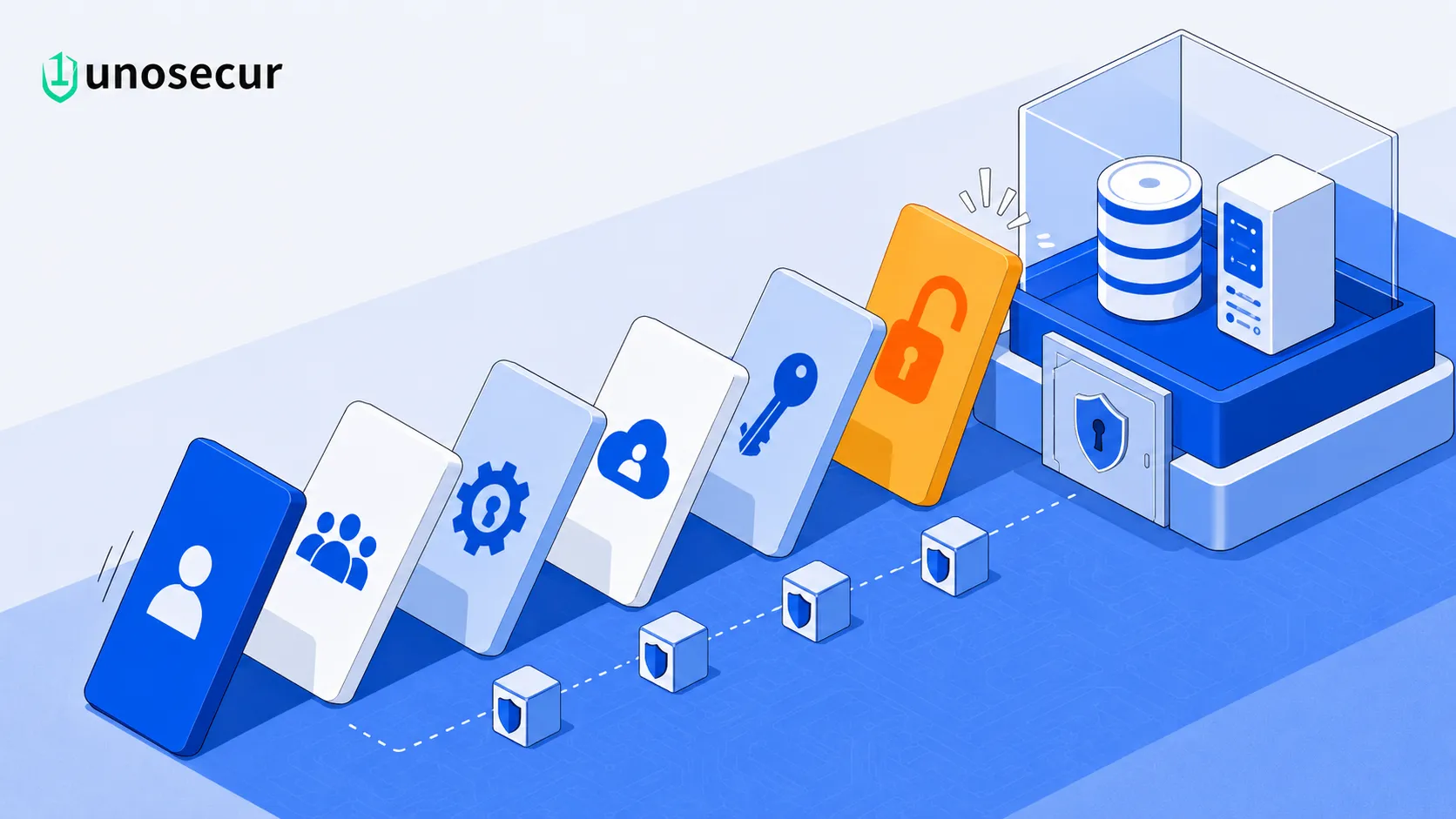
A developer gets temporary administrator access and keeps it. A service account receives a broader role because the correct permissions take longer to configure. An employee changes teams, but no one removes access from their previous role. Nothing has been hacked yet. But the conditions for a much larger security incident may already be in place.
This is the problem with identity system misconfigurations. They rarely look like attacks. They appear as legitimate users, valid permissions, approved integrations, and normal administrative changes. The risk becomes visible when someone compromises or abuses one of those identities.
Recent incident-response research shows why that distinction matters. Palo Alto Networks Unit 42 reported in its 2026 Global Incident Response Report that identity weaknesses played a material role in nearly 90% of the incidents it investigated. The same research found identity-based techniques accounted for 65% of initial access. Those figures do not mean every identity-related breach starts with an IAM configuration error. They show something more useful: once identity becomes part of an attack, the permissions attached to that identity can determine what happens next.
The question security teams need to ask is no longer only, "Was this identity compromised?" It is also, "What could this identity do if it were compromised?"
Why do identity misconfigurations become security problems?
An IAM misconfiguration is an identity or access configuration that creates more access than the organization intended. Sometimes the problem is obvious, such as administrator permissions assigned to a normal user. More often, the dangerous access is hidden behind groups, inherited roles, cloud policies, service accounts, application permissions, and trust relationships.
Consider a developer who needs temporary access to troubleshoot production. An administrator grants the developer a privileged role. The incident ends, but the role stays attached. Six months later, an attacker steals the developer's session token.
The original mistake did not cause the compromise. It changed its potential impact. Instead of compromising a developer account, the attacker has effectively compromised a privileged identity. This is why access control gaps deserve the same attention as authentication failures. Strong MFA can reduce account takeover risk, but it cannot correct permissions that should never have existed.
Where do IAM misconfigurations actually come from?
Most organizations do not intentionally create unsafe identity environments. Access accumulates as the business changes.
Temporary access becomes permanent access.
Someone needs elevated access for a migration, an incident, a deployment, or a customer issue. Access is approved quickly because work needs to continue. Removing it rarely carries the same urgency. Over time, these exceptions create excessive permissions across users and administrators. If nobody measures actual permission usage, the organization may have little evidence that those privileges are still necessary.
People change roles, but their permissions do not.
Joiner, mover, and leaver processes often focus heavily on account creation and termination. Movers create a different problem. An engineer moves into product management. Their new access arrives, but engineering permissions remain. Another internal move adds another set of entitlements. That is privilege creep. Each grant may have been legitimate when issued, while the combined access no longer reflects the person's job.
Machine identities accumulate powerful permissions.
The same problem extends beyond employees. Service accounts, service principals, workloads, APIs, automation tools, OAuth applications, and AI agents all require access. Teams often grant broader permissions to these identities because narrowing policies can break applications. The result can be a non-human identity with persistent credentials and broad access that nobody regularly reviews.
Cloud permissions combine in unexpected ways.
One of the hardest categories of cloud IAM errors occurs when several legitimate permissions combine to form a dangerous path. A user may not have direct administrator access. But they might be able to modify a role, pass that role to a service, assume another identity, or access credentials belonging to a more privileged workload. Looking at each permission separately can make the account appear safe. Looking at the complete access path tells a different story.
The dangerous permission is often the one nobody notices
This is where identity security gets harder. Most IAM tools are good at telling you what has been configured. Security teams need to know what that configuration makes possible. Suppose two employees both have ten permissions.
The first can read documentation, view monitoring data, and access a development environment.
The second can modify an IAM policy that controls a service role. That service role can access production secrets.
Counting permissions tells you both users have ten. Understanding effective access tells you only one can potentially reach production. That difference is central to identity security posture. The real security question is not how many permissions an identity holds. It is what resources the identity can ultimately reach, what privilege it can obtain, and which paths become available if the identity is compromised.
IAM misconfiguration examples worth investigating first
Security teams cannot review every entitlement with equal urgency. Start with configurations that can materially change an attacker's reach.
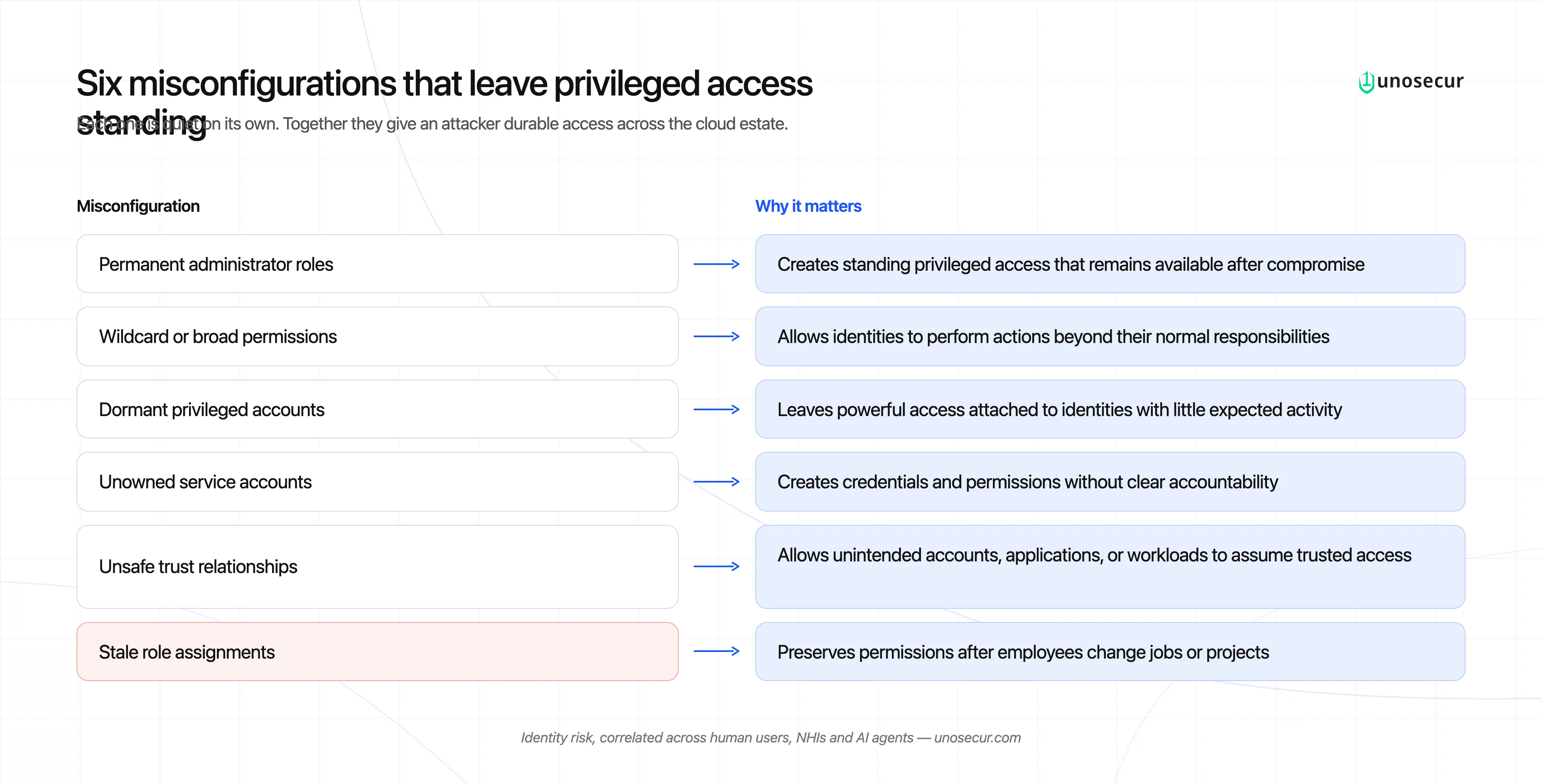
These IAM misconfiguration examples share one property: they increase the blast radius of identity compromise.
That makes prioritization possible.
A dormant account with no meaningful permissions deserves attention. A dormant account that can modify production IAM policy deserves immediate attention.
Why do periodic IAM reviews miss the real problem?
Many organizations already perform access reviews. The limitation is timing and context. A quarterly review captures one moment. Cloud environments can change hundreds or thousands of times between reviews. New identities appear, roles change, workloads get deployed, and temporary exceptions accumulate. The reviewer may also see a role name without understanding its effective permissions.
"Developer-Prod-2" tells you very little unless you know what the role can access, how the user obtained it, when they last used it, and whether those permissions create another privilege path. Effective review, therefore, requires three forms of context: entitlement, activity, and risk.
This is where least privilege becomes operational rather than theoretical. The goal is to identify access that an identity can use but no longer needs.
Treat identity configuration as a continuous security problem.
You cannot prevent every configuration mistake. You can reduce the time it remains invisible. That starts with continuously discovering human and non-human identities, mapping their effective access, identifying dangerous combinations of privileges, and comparing granted permissions with actual usage.
Unosecur's Unified Identity Fabric approaches identity security across cloud, SaaS, identity providers, and other connected systems. It helps teams discover human, non-human, and AI identities, understand access relationships, identify excessive privilege, and act on risky identity configurations.
The shift matters. Instead of waiting for an access review to ask, "Who has this role?", security teams can ask better questions: Who can reach this critical resource? How did they get that access? Are they using it? Can this permission lead to greater privilege? Does the access still make sense? That is how IAM misconfigurations move from an administrative hygiene problem to a problem that security teams can continuously investigate and reduce.
Because the most dangerous access problem is often not the permission an attacker creates. It is the permission you gave them months ago.



.png)
%201.svg)




.webp)

.avif)