
%201.svg)

.png)
A user signs in with valid credentials from a managed laptop. Their role permits access to a finance application. But the request arrives from an unusual location, outside normal working hours, after the account has triggered a high-risk session alert.
RBAC vs ABAC determines how much of that context your authorization layer can use. For Zero Trust access management, the right answer is often not one model replacing the other. It is deciding which access decisions can remain role-based and which need real-time attributes.
RBAC and ABAC make access decisions differently
Role-based access control assigns permissions to roles, then assigns users or identities to those roles. A finance analyst may receive read access to reporting systems because the analyst role already contains those permissions.
RBAC works well when job functions are stable, and permissions can be grouped predictably. Instead of maintaining individual grants for every user, security teams manage access through roles that reflect defined responsibilities.
Attribute-based access control evaluates attributes attached to the subject, resource, requested action, and sometimes the environment. NIST SP 800-162 defines ABAC around policies that evaluate these attributes and conditions before permitting an operation.
That difference changes how the two access control models behave.
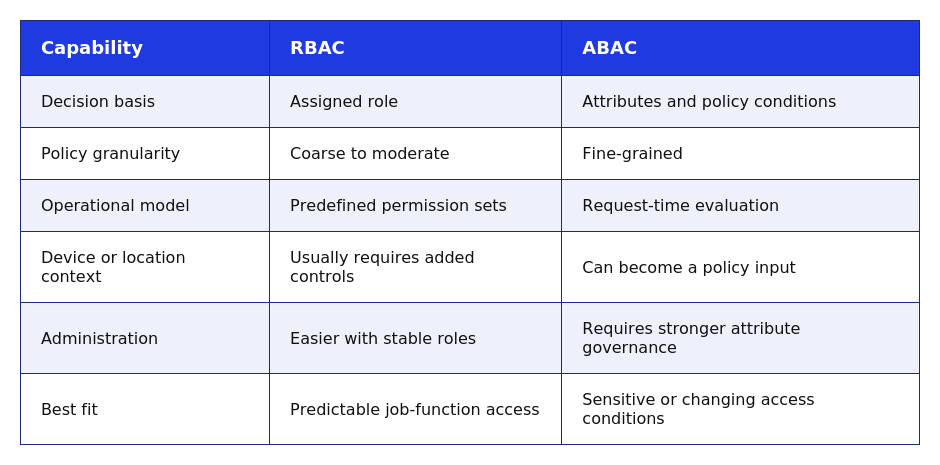
RBAC answers, “What can someone in this role do?” ABAC can answer, “Can this identity perform this action on this resource under these conditions?”
Zero Trust needs more than a static role check.
NIST Zero Trust Architecture states that access decisions should use dynamic policy informed by identity, asset state, behavioral signals, and environmental attributes. Zero Trust does not mandate ABAC as the only authorization model. Still, it does require access decisions to move beyond implicit trust based on network position or a previous authentication event.
That is the main limitation of RBAC in Zero Trust access management. A role can establish baseline entitlement, but the role alone cannot determine whether the current request remains safe. Consider an administrator role that permits production database access. RBAC can verify that the user is an administrator. Context-aware authorization can also evaluate device health, session risk, location, time, resource sensitivity, or a recent privilege change before allowing the request.
ABAC is therefore stronger for dynamic access control where conditions can change between requests. The cost is greater policy complexity. Attributes must be accurate, available at decision time, consistently named, and governed across systems.
Choose RBAC for stable permissions and ABAC for variable risk.
The choice becomes clearer when you separate baseline authorization from conditional authorization. Use role-based access control when access follows durable business responsibilities. Accountants, developers, support staff, and HR administrators often need predictable permission sets that map cleanly to their work.
Use attribute-based access control when the same identity should receive different outcomes depending on context. A contractor may access one project only during an approved contract period. A privileged user may receive write access only from a compliant device. A service identity may call an API only for a specific workload or environment.
The security objective is least-privilege access. RBAC can reduce permission sprawl by grouping known permissions into controlled roles. ABAC can narrow those permissions further at request time.
The failure modes differ as well. RBAC can create role explosion when teams add a new role for every exception. ABAC can create policy sprawl when teams introduce attributes and conditions without common ownership, schemas, or policy standards. The decision is therefore less about which model is more advanced. It is about how much information the authorization decision needs.
A hybrid access control model usually fits Zero Trust better.
For many enterprises, hybrid access control provides a cleaner architecture. RBAC establishes the baseline. ABAC adds conditions around higher-risk actions. A developer role might permit access to a cloud console. In contrast, an attribute policy permits production changes only when the device is compliant, the session risk is acceptable, and an approved change window is active.
This approach keeps routine authorization understandable while reserving granular policy evaluation for decisions that need it. It also avoids forcing every access request into an unnecessarily complex attribute policy. The architecture still depends on identity context. Your policy layer cannot evaluate entitlement history, privilege changes, resource relationships, or identity risk if those signals remain isolated across directories, identity providers, cloud platforms, and SaaS applications.
Unosecur's Unified Identity Fabric connects identity signals across human and non-human identities and maps relationships between users, roles, service accounts, keys, and entitlements. The platform also supports policy-based provisioning and revocation, least-privilege enforcement, runtime monitoring, and risk-based prioritization.
Its live identity visibility shows both the permissions an identity has and the permissions it uses. That context helps security teams identify standing access, privilege paths, and risky entitlements before deciding where stricter least-privilege access controls are required.
The access-control choice should therefore start with the decision itself. Use roles where business function is enough. Use attributes where access depends on changing context. Combine them where Zero Trust requires predictable administration and continuous verification.



.png)

%201.svg)




.png)

.png)