.avif)





%201.svg)

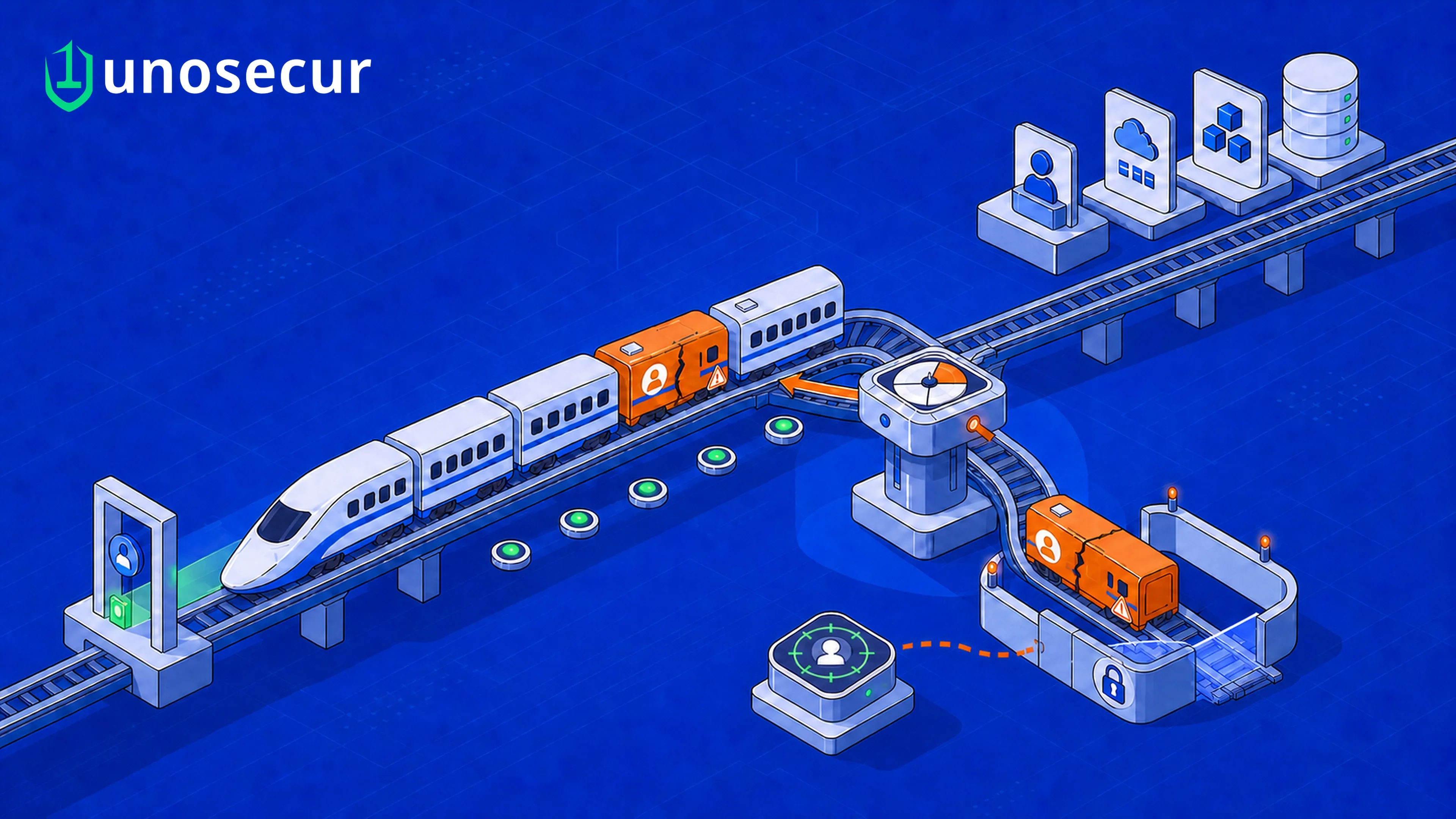
An attacker uses a stolen session token to access a SaaS application. The login succeeds. The attacker assumes a privileged role, queries sensitive data, then pivots into another connected system. Each action uses an identity the environment already trusts.
If your SOC identifies the attack 30 minutes later, the alert can be accurate and still arrive too late. That is why identity threat detection and response in 2026 is increasingly measured by detection and containment speed, not alert volume alone.
Identity attacks can look like legitimate activity.
Endpoint-centric detection works well when an attacker drops malware, launches an abnormal process, or changes a protected file. Identity attacks can behave differently. Attackers may reuse passwords, refresh tokens, browser cookies, OAuth grants, service accounts, or cloud credentials. Authentication succeeds because the credential itself is valid.
CrowdStrike's 2026 Global Threat Report found that 82% of detections in 2025 were malware-free. Adversaries increasingly operated through valid credentials, trusted identity flows, SaaS applications, and other authorized paths.
That changes credential theft detection. A SOC cannot depend on a failed login or malware alert. It needs to evaluate what the identity did after authentication, what privileges it obtained, which resources it reached, and whether that activity fits its normal behavior. This is the purpose of real-time identity monitoring. Authentication becomes one signal in a continuing identity session rather than the final security decision.
Five-minute MTTD is an operating target, not a compliance threshold.
Mean time to detect measures the interval between malicious activity beginning and the SOC identifying it as a threat. Mean time to respond measures how quickly defenders contain or resolve the incident after detection. Microsoft identifies both MTTD and MTTR as core SOC performance metrics. No universal regulation requires five-minute identity detection.
The benchmark reflects the speed defenders now need. Unosecur's 2026 ITDR guidance uses five-minute MTTD/MTTR as the target for interrupting privilege escalation, lateral movement, and credential misuse before an attacker progresses further through the environment. Attack speed makes that target easier to understand. CrowdStrike reported a fastest observed eCrime breakout time of 27 seconds in its 2026 research.
For an ITDR 2026 program, the useful question is therefore not whether every incident can be resolved inside five minutes. It is whether your architecture can detect high-confidence identity abuse and begin containment within that window. That makes MTTD/MTTR identity metrics as much an architectural measure as a SOC measure. Slow detection often points to fragmented telemetry, weak behavioral context, manual correlation, or response actions spread across several consoles.
ITDR needs identity context that a SIEM alone doesn't provide.
The ITDR vs SIEM question is often framed as a product choice. In practice, they do different jobs. A SIEM collects and correlates security events across many domains. ITDR focuses on the identity layer, where the SOC needs to understand permissions, sessions, authentication, privilege changes, trust relationships, and behavior as one connected security problem.
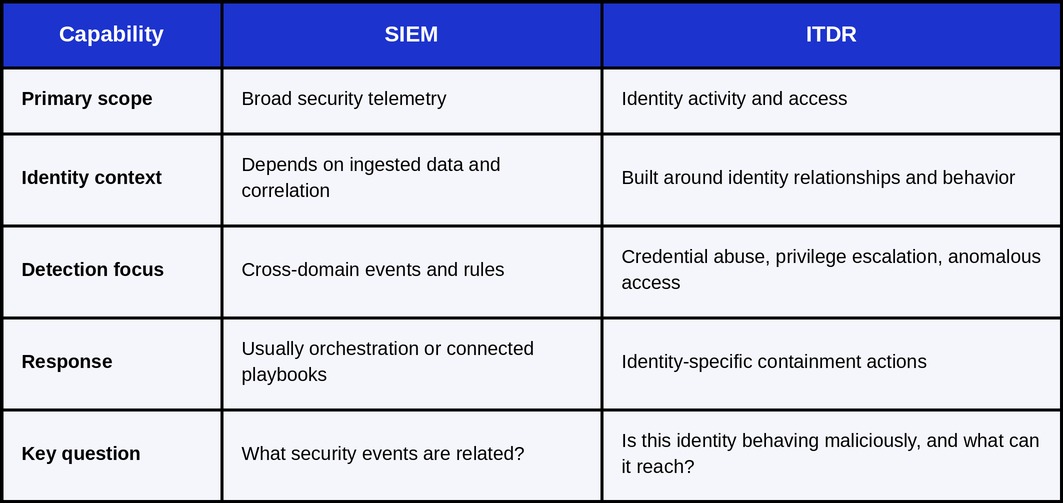
Microsoft Entra ID Protection illustrates the complementary model. Identity risk detections can drive access decisions directly or be sent into a SIEM for investigation and broader correlation. The distinction matters for identity attack detection because effective access rarely exists in a single log line. A suspicious login becomes far more meaningful when the same identity has just received a new role, accessed an unusual resource, or started behaving differently across SaaS and cloud systems.
Fast ITDR connects detection directly to containment.
Reducing MTTD without reducing response time leaves part of the attack window open. An effective automated identity response workflow should enrich a detection with identity context, determine the likely blast radius, and execute an approved containment action while the incident is still active. Depending on the identity and threat, that response may include terminating sessions, revoking tokens, deactivating an account, removing newly acquired privileges, rotating compromised credentials, or blocking further access to a sensitive resource.
The response should also preserve evidence. Analysts still need the authentication history, permission changes, resource activity, affected identities, and timeline required to determine how the attacker entered and what happened next. That is where fragmented identity tooling creates friction. A SOC may have the authentication event in an identity provider, entitlement data in a cloud console, SaaS activity elsewhere, and the response control in another system.
Fast identity threat detection and response depends on joining those signals before an analyst has to reconstruct them manually.
A unified identity fabric gives the SOC the context to move faster.
Unosecur's Unified Identity Fabric connects identity sources into a common graph covering users, roles, service accounts, keys, entitlements, and AI agents. The platform combines MITRE ATT&CK and machine-learning-driven detection with runtime alerts, forensic context, and risk-based prioritization.
Its live identity visibility continuously tracks permissions and activity across human and non-human identities. That lets the SOC evaluate suspicious behavior against the identity's access path rather than treating each event as an isolated alert.
When compromise is confirmed, Unosecur can support containment actions such as session revocation, access-token invalidation, privilege rollback, and key rotation through the same identity context used during investigation. Five-minute detection is therefore less about making analysts click faster. It is about removing the correlation and response delays that consume those five minutes.
Attackers already operate through trusted identities. Your SOC needs to recognize when that trust has been stolen before the attacker has time to use it.





.png)
%201.svg)




.webp)

.avif)
.webp)