
%201.svg)

Two enterprise AI agent security solutions can both promise discovery, governance, and runtime protection while providing very different levels of control once an agent reaches production. One may inventory agents but not show what they can actually access. Another may monitor prompts but have no authority over the credentials, tools, or downstream permissions that determine what an agent can do. A third may detect risky behavior but leave containment to an analyst working across several consoles.
That is the problem enterprise buyers need to test. The best AI agent security tools for enterprise environments should answer three questions continuously: which agents exist, what authority does each one currently have, and what happens when an agent acts outside its intended scope.
The following 12 capabilities provide a practical way to evaluate that.
1. Continuous AI agent discovery should come before policy enforcement
An enterprise cannot govern agents that never appear in its security inventory. Evaluate whether the platform continuously discovers agents across cloud providers, AI platforms, SaaS applications, development environments, and agent frameworks rather than relying on manual registration. Discovery should also identify the credentials, service accounts, OAuth grants, tools, owners, and environments associated with each agent.
This matters because agents can enter production through several paths. Microsoft now recommends registering agents and assigning each one its own identity. At the same time, enterprise agent-security guidance increasingly treats shadow-agent discovery as an operational requirement rather than an asset-management exercise.
Evaluation test: Deploy or connect an agent outside the security team's normal provisioning workflow. Measure how quickly the platform finds it and how much context it provides without manual enrichment.
2. Every agent should have a distinct identity and accountable owner
Shared credentials make an autonomous workflow difficult to govern. A strong AI agent security platform should distinguish an agent acting independently from an agent acting on behalf of a user. It should associate the agent with a unique identity, business purpose, human owner, environment, credentials, and lifecycle state.
Microsoft's 2026 guidance recommends treating agents as first-class principals with dedicated identities rather than reused service accounts. That identity becomes the basis for permission assignment, revocation, auditability, and incident attribution.
The buyer's question is therefore not simply whether the platform can display an agent. It is whether security teams can identify who is accountable for its authority.
Evaluation test: Select an agent at random and ask the platform to show its owner, purpose, credentials, delegated user context, and every system in which that identity appears.
3. Permission analysis should show effective authority, not assigned roles alone
An IAM role rarely tells the complete story of what an agent can reach. Agents can inherit access through service accounts, nested roles, OAuth scopes, tool credentials, downstream APIs, and permissions held by the systems they invoke. A platform that only reports the agent's directly assigned permissions can therefore substantially underestimate its blast radius.
This matters because OWASP lists identity and privilege abuse among its Top 10 risks for agentic applications in 2026. Tool misuse is another major risk, which means the security boundary extends beyond the agent itself into the systems the agent can activate.
Effective authority analysis should connect those paths and show the resources that become reachable when you consider the full chain.
Evaluation test: Ask each vendor to calculate the blast radius of one production agent. Require them to include indirect roles, tool permissions, delegated access, and downstream resources, not just the agent's IAM policy.
4. Least privilege should be based on actual agent activity
Static role templates are not enough for agents whose workflows change over time. The platform should compare permissions granted with permissions actually exercised, identify unused or excessive access, and recommend a narrower policy. Mature implementations should also support temporary elevation so an agent can receive additional authority for a specific task without retaining it permanently.
Microsoft recommends task-based roles, narrowly scoped permissions, controlled tool access, and just-in-time elevation for agent workflows. It also recommends defining scope across resources, data, and operations such as read, write, export, and administration.
This turns least privilege from an initial configuration exercise into a continuing control.
Evaluation test: Give an agent ten permissions when it routinely uses only three. Determine whether the platform can identify the unused seven and produce an actionable right-sizing recommendation.
5. Tool and MCP access should have its own enforcement layer
An agent's authority increasingly depends on the tools connected to it. Email, file storage, databases, ticketing systems, code repositories, browsers, APIs, MCP servers, and automation platforms can all expand what an agent can do. Security teams therefore need visibility into which tools an agent can invoke and policy control over individual actions within those tools.
OWASP identifies tool misuse and agentic supply-chain vulnerabilities among the major agentic risks for 2026. Microsoft similarly recommends explicit tool allowlists and warns that granting broad tool access can expand an agent's effective authority even when individual permissions appear limited.
For enterprises adopting MCP, this control should extend to authentication, authorization, sessions, tool calls, and the credentials used to reach downstream systems. For a closer look at what that control should cover in practice, see a practical checklist for governing AI agents without slowing them down.
Evaluation test: Connect an agent to a tool containing both low-risk and destructive operations. Verify whether the platform can allow the required function while denying actions such as deletion, privilege modification, or unrestricted export.
6. Runtime monitoring should understand normal agent behavior
An agent can remain properly authenticated and still behave dangerously. The platform should baseline how an agent normally accesses resources, invokes tools, changes permissions, transfers data, and interacts with other identities. Security teams should then detect deviations while the workflow is active.
That distinction matters because agent security is not limited to login events. An authenticated agent suddenly accessing a new repository, invoking an unfamiliar tool, or performing administrative actions can represent a more useful signal than authentication alone.
Microsoft recommends monitoring agent behavior and alerting on deviations such as new endpoints, expanded parameters, and unusual query patterns.
Evaluation test: Change a normal agent workflow so that it begins reaching a sensitive resource or invoking a previously unused privileged tool. Measure whether the behavioral change produces a meaningful alert.
7. Threat detection should cover agent-specific attack paths
Traditional identity anomalies remain relevant, but they do not cover the full agentic attack surface. The AI agent security software under evaluation should account for risks such as agent goal hijacking, tool misuse, identity and privilege abuse, memory and context poisoning, insecure inter-agent communication, cascading failures, and rogue agent behavior.
Those categories now appear in OWASP's Top 10 for Agentic Applications for 2026. OWASP's 2026 incident research also documents security failures involving agent identities, excessive agency, tool exploitation, unsafe access changes, and compromised orchestration components.
Coverage should be demonstrated through detections and controls, not a compliance mapping page alone.
Evaluation test: Ask vendors to map their native detections against the OWASP Agentic Top 10 and identify which risks they detect at runtime, which they prevent, and which require another product.
8. High-impact actions should support deterministic approval gates
Autonomy should not imply unlimited decision authority. Actions such as deleting data, sending messages externally, changing access policies, initiating payments, publishing content, exporting sensitive information, or modifying production resources may need explicit human approval regardless of how confident an agent appears.
OWASP's guidance on excessive agency recommends human approval for high-impact actions. Microsoft similarly describes human-in-the-loop controls as an important governance backstop for autonomous agents.
The key requirement is that policy enforces approval rather than leaving it to a prompt asking the model to seek permission.
Evaluation test: Configure a prohibited or approval-required operation and attempt to make the agent execute it through indirect instructions. The security control should hold even if the model decides that the action is reasonable.
9. Data access controls should remain enforceable after the agent starts reasoning
Protecting the initial prompt does not protect every subsequent resource an agent reaches. An enterprise platform should preserve data boundaries as agents retrieve files, query databases, access SaaS records, invoke APIs, and pass context into other tools. Policies should account for resource sensitivity, user delegation, agent identity, environment, and the requested operation.
Google's 2026 agentic-security architecture emphasizes treating agents as first-class identities while enforcing boundaries around their access to services and data. Microsoft's guidance similarly recommends scoping permissions across resource, data, and operation boundaries.
The platform should therefore control access when the resource is requested, not rely solely on what the model was instructed to do.
Evaluation test: Give an agent access to a repository containing both ordinary and restricted information. Determine whether controls can allow the legitimate workflow without making the entire repository available.
10. Lifecycle controls should cover credentials, permissions, and agent retirement
Agent inventories become stale quickly when lifecycle governance is separated from deployment. Buyers should look for ownership reviews, credential rotation, entitlement expiry, inactivity detection, decommissioning workflows, session termination, and immediate revocation. An agent disabled in an inventory but retaining a valid token or downstream credential is not actually retired.
Microsoft's current guidance recommends lifecycle-managed agent identities with onboarding controls, credential rotation, suspension procedures, decommissioning, and a shutdown mechanism that can invalidate credentials and tokens.
This becomes increasingly important as development teams create temporary agents for experiments, projects, and internal automation. For a complete breakdown of what that lifecycle should look like end to end, see our guide to agent lifecycle security, from provisioning to decommissioning.
Evaluation test: Decommission an agent and verify that its sessions, tokens, roles, tool access, and downstream credentials are removed, not just that its status changes in the security console.
11. Detection should connect directly to containment
An alert is only useful if defenders can close the exposure quickly enough. Strong enterprise AI agent security solutions should support actions such as suspending an agent, terminating sessions, revoking tokens, removing privileges, disabling credentials, blocking a tool invocation, or isolating access to sensitive resources.
The platform should also preserve human control over destructive remediation where required. Automated response is most valuable when high-confidence conditions are predefined, and the evidence behind the action remains visible to the analyst.
Runtime containment is also one of the areas highlighted in OWASP's 2026 agent-security governance work as agentic systems mature.
Evaluation test: Trigger a high-confidence privilege-abuse scenario and measure the number of consoles, manual steps, and minutes required to stop the agent from continuing.
12. Auditability should reconstruct authority as well as activity
A log saying that an agent called an API does not explain why the call was allowed. Enterprise investigations need to reconstruct the identity involved, delegated user context, permissions, tool invoked, resource accessed, policy decision, approval state, credential used, resulting change, and subsequent activity.
Microsoft warns that logging model output without the underlying tool invocations, scopes, and authorization decisions creates an audit trail with limited forensic value.
A mature platform should preserve this context in a searchable timeline and export the evidence into the organization's existing SIEM, ticketing, and compliance workflows.
Evaluation test: Choose one sensitive action from the previous week and ask the platform to explain who or what initiated it, under whose authority, which policy permitted it, what changed, and what the agent did next.
A buyer's scorecard for AI agent security software
The 12 capabilities become more useful when procurement teams evaluating AI agent security tools for enterprise environments turn them into evidence requirements rather than feature checkboxes.
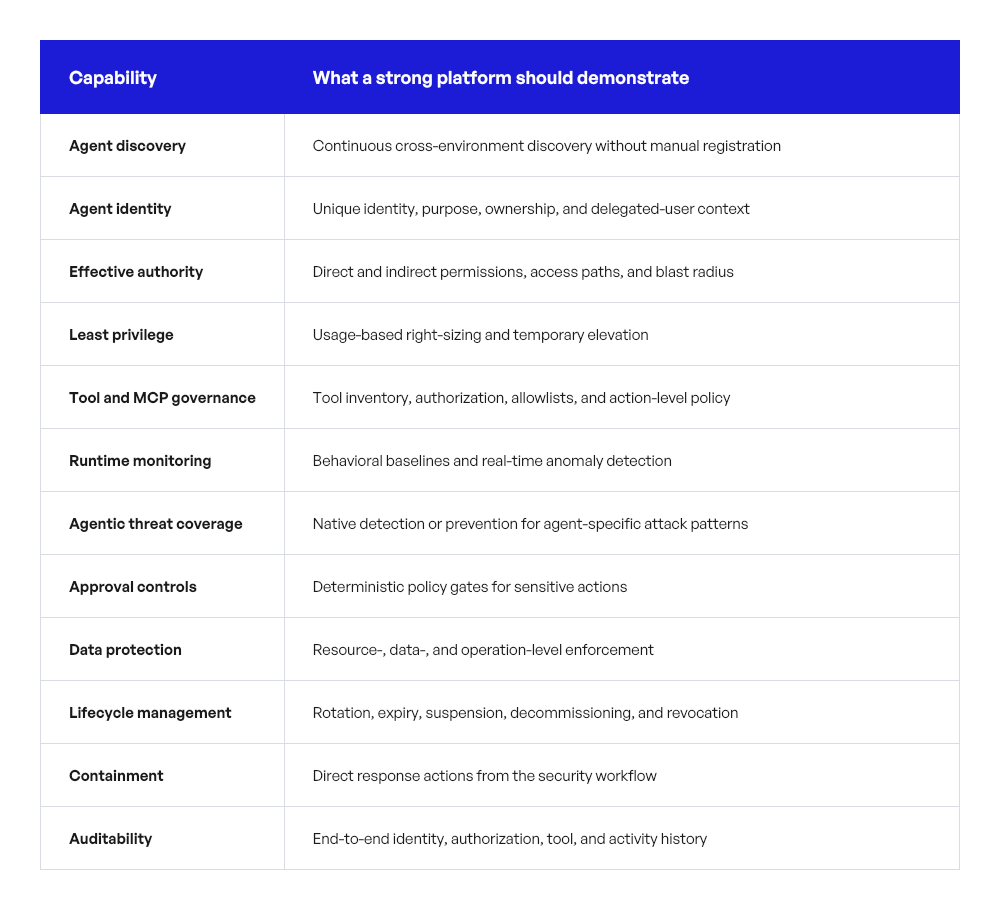
A vendor does not need to implement every control in the same architectural layer. Enterprises already have investments in IAM, SIEM, CNAPP, DLP, PAM, secrets management, and application security. The requirement is that the complete control path exists and can be demonstrated.
If answering a basic question such as "What can this agent reach right now?" requires data from four products and manual correlation, the architecture still has an operational gap.
Where Unosecur fits into the evaluation
As an AI agent security platform, Unosecur approaches agent security through the identity layer, and it's a useful reference point for what enterprise AI agent security solutions look like when discovery, authority, activity, and containment share one identity model instead of four disconnected tools.
Its Unified Identity Fabric correlates human identities, non-human identities, and AI agents across connected cloud, SaaS, identity-provider, and on-premises environments. Current platform capabilities include automated identity discovery across more than 100 integrations, permission and activity analysis, behavioral monitoring, risk prioritization, runtime threat detection, policy enforcement, remediation, and audit trails.
For AI agents specifically, the platform surfaces events, effective permissions, accessible resources, and associated risks rather than treating the agent as an isolated service account. Unosecur's identity graph is also designed to expose access relationships and downstream reach that remain hidden when permissions are reviewed system by system. Learn more about how Unosecur approaches agent identity governance here.
Its access-governance layer includes activity-based right-sizing, Just Enough Privilege, and just-in-time access. For MCP-connected workflows, Unosecur extends the same identity model into an MCP gateway that handles authentication, authorization, sessions, tool access, and audit evidence at the agent-to-tool boundary.
That combination matters because securing an agent isn't a single control. Discovery without access context leaves security teams unable to measure exposure. Least privilege without runtime monitoring cannot tell them when legitimate access begins behaving differently. Detection without revocation leaves the agent active after the alert.
The useful buying question, then, is not which vendor has the longest AI security feature list. It is whether the platform can follow an agent from discovery to authority to activity to containment without losing the identity context between those stages. That is the bar the AI agent security tools for enterprise environments in this guide should clear.



.webp)
.webp)
%201.svg)



.png)

.avif)