
%201.svg)

The process begins with a simple, logical requirement. A team engineers an agent to automate a specific friction point, such as verifying order statuses. It performs flawlessly. Following a successful demo, stakeholders demand immediate scale. This velocity is the catalyst for hidden danger.
These agents typically reside on existing cloud infrastructure. However, the requisite data often lives elsewhere, siloed in legacy systems designed long before the advent of autonomous agents. Closing this distance usually falls to whichever engineer has a gap in their sprint: a recipe for technical debt.
To meet the deadline, the engineer scripts a quick connector and embeds an access key for authentication. Pursuing the "correct" path, establishing cross-cloud trust without static keys, would require a week of governance meetings and extensive documentation. Storing the key takes ten minutes; the feature ships on Friday.
This isn't laziness. It is the path of least resistance between a requirement and a production feature. The engineer delivered exactly what the organization rewards: raw velocity over architectural integrity.
The invisible approval path
Traditional security operations rely on a clear audit trail: a user requests access, a manager approves it, and a log archives the justification. Most enterprise tools are built to monitor this specific, predictable sequence.
A connector registration bypasses this entirely. There is no formal request because the agent is simply piggybacking on an existing identity. There is no risk evaluation because a configuration tweak rarely triggers a security review. Ultimately, no record of the decision exists because, technically, no formal decision was ever made.
This is precisely why modern audits fail to catch it. They are tuned to find deliberate grants, yet they are blind to access that emerges as a side effect of rapid feature development.
Boundaries without ownership
Inspect the primary cloud, and it reveals a benign account with minimal scope. Inspect the secondary cloud, and it shows a valid external credential. Examine the agent's configuration, and it merely points to a connector. All three data points are technically accurate, but none reflect the actual, terrifying blast radius.
When viewed end-to-end, the security gap is glaring. When viewed through a single cloud console, it is invisible. The core issue is fragmented ownership. One team manages Cloud A; another manages Cloud B. The agent team owns the application logic. The connection bridging them belongs to no one. That "no man's land" is where the systemic risk resides.
From one connector to production write access
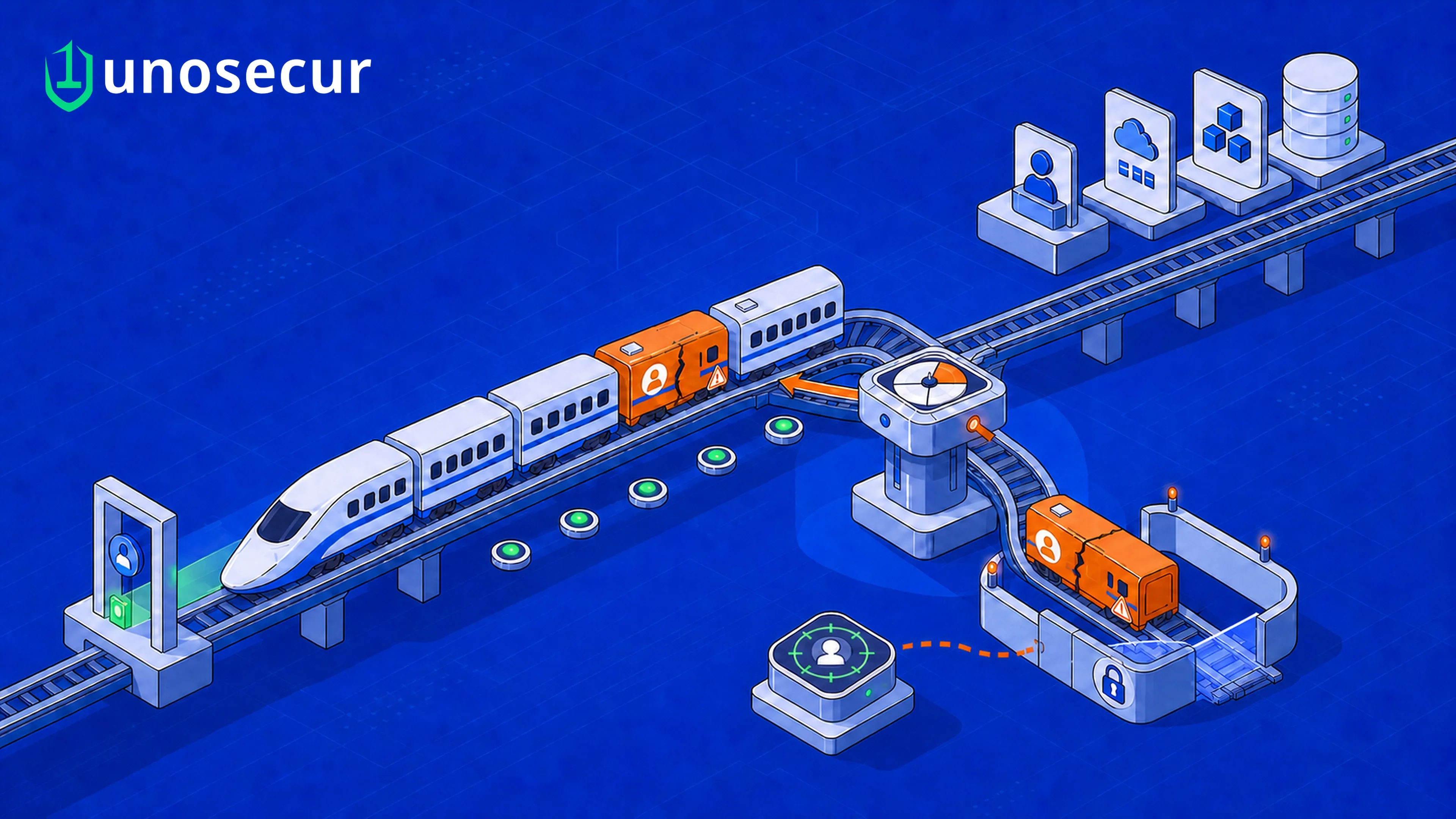
Consider that initial connector. Because it works, the next project adopts it to save time. Then another team follows suit. Within months, a fleet of agents is relying on a single, shared credential of opaque origin.
If that credential was originally provisioned for a legacy data-sync job, it likely carries write permissions. Suddenly, an agent designed for read-only lookups possesses the latent power to delete production records at scale.
This isn't the result of a hack; it is the result of individual rational choices. However, because connectors are shared, the complexity of paths through your environment grows exponentially. Doubling your agent count doesn't just double your risk: it multiplies it.
The evolution of sprawl
One might argue this is just a new flavor of over-privileged service accounts, a problem we have managed for decades. In this view, an agent is just another workload with a key. That view is dead wrong. Traditional service accounts were provisioned with explicit intent. Even if poorly scoped, they exist as searchable objects. Agent access is different: it is constructed from incremental configuration changes that never trigger security alerts.
Furthermore, while a service account's reach has historically been stable, an agent's reach expands each time a new connector is integrated. This happens within a sprint, far removed from the identity provider. Your inventory might claim a credential hasn't changed in a year, while its actual capabilities have tripled.
When misuse mimics usage
Standard monitoring looks for anomalies, but an agent overstepping its bounds can use a perfectly valid identity. It doesn't trigger 403 errors. Its traffic appears legitimate. Because agents operate in fast, irregular bursts, you cannot use traffic volume as a signal when "erratic" is the baseline.
The only reliable signal is a shift in which resources an identity touches. To detect that, you must first define the expected scope of its reach: a task most organizations ignore.
The mandate for end-to-end visibility
Organizations must bridge the ownership gap. Currently, access that spans disparate cloud environments belongs to no one. Until security teams take responsibility for the connection itself, these vulnerabilities will recur with every new connector written.
These chains must be mapped before a failure occurs. Least privilege is a claim about scope, not just a theoretical ideal. Attempting to map these connections during an active incident is a losing strategy. An incomplete map is dangerous: it provides a false sense of security while the actual vulnerability remains unaddressed.
AI agents are a permanent fixture of modern architecture. They should be. But when an agent moves to production, the organization must be able to state, with absolute certainty, exactly how far its reach extends. The era of the "nobody zone" must end.
This is the gap we built Unosecur to close. Our identity fabric continuously discovers every agent across your cloud and SaaS stack, traces the full access path from the agent to the resources it can actually reach, and compares granted permissions against observed behavior so least privilege becomes something you measure rather than something you assert.
If your agents are already in production, start with the reach you cannot see today. See how Unosecur governs AI agent identities.


.webp)
.webp)
%201.svg)


.png)

.avif)