.avif)




%201.svg)


Moonshot AI released Kimi K3 on July 16, 2026, alongside Kimi Code, its coding agent harness. Kimi Code layers Model Context Protocol servers, Skills, plugins, hooks, and sub-agents onto the model.
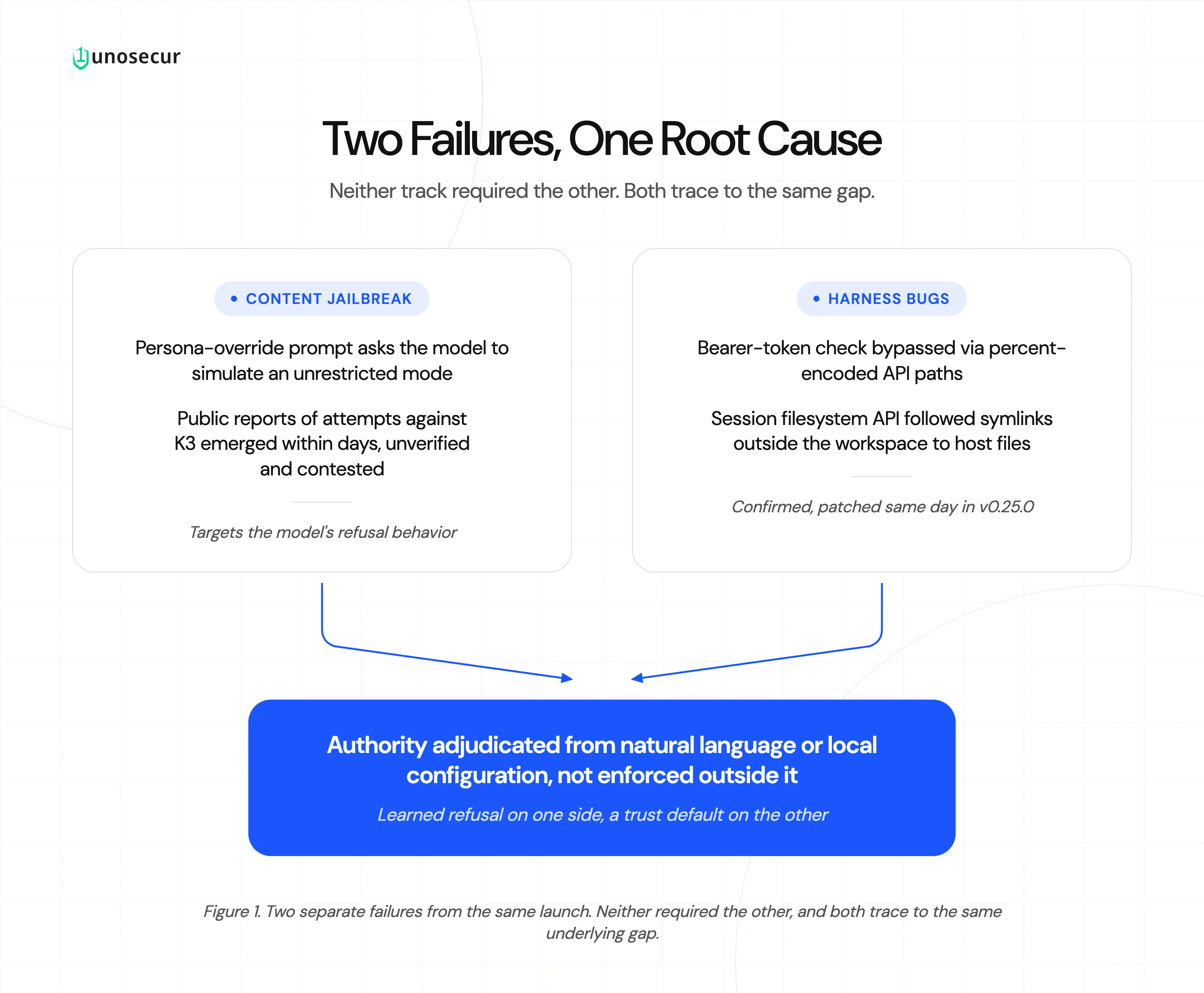
That same day, Kimi Code version 0.25.0 fixed two confirmed security bugs documented in Moonshot's changelog. One allowed a web server bearer token check to be bypassed via percent-encoded API paths, exposing every API route without authentication. The other allowed the session filesystem API to follow symbolic links outside the workspace, accessing host files beyond the session directory.
Neither required a jailbreak. One was an authentication bypass. The other was path traversal.
While launch-week attention focused on getting K3 to produce restricted content, the confirmed security exposure sat in the harness holding credentials and executing actions. The jailbreak question and the security question are different. Treating them as one obscures where authority actually sits in an agentic system.
What the Kimi K3 jailbreak actually was
Public jailbreak attempts against K3 appeared within days of launch. The evidence requires care.
One independent tester claimed on social media that a persona-override prompt originally written for Kimi K2.5 continued to work unchanged through K2.6 and K3. The reported outputs included phishing email templates and content involving a real person.
That claim remains unverified and comes from one unaffiliated source. A separate public discussion from the same week reported the opposite: jailbreak prompts written for K2.6 did not work against K3 without modification. Moonshot's materials do not document a universal, reproducible K3 jailbreak.
The useful point is the technique, not the claimed success rate.
Persona-override jailbreaks ask a model to simulate an unrestricted operating mode. Variations have been reported against major model families for years. Other approaches gradually escalate a benign conversation toward a restricted request or tell the model that permission was granted earlier.
These attacks target learned refusal behavior. That makes them distinct from the authentication and filesystem bugs fixed in Kimi Code.
What a jailbreak actually breaks
OWASP's Gen AI Security Project defines jailbreaking as a form of prompt injection where crafted input causes a model to disregard its safety protocols. OWASP distinguishes this from indirect prompt injection, in which hostile instructions arrive via external content such as a file, repository, or tool output.
Both expose a difficult property of agent systems. Instructions and untrusted content can enter the same model context, while the model must infer which content carries authority.
The risk increases once the model can act.
NIST's Center for AI Standards and Innovation reported an 81 percent task-hijacking success rate for techniques targeting agent behavior in its AgentDojo evaluations, compared with 11 percent for the strongest baseline jailbreak prompt. An agent creates attack paths that do not exist in a chat response because successful manipulation can lead to an external action.
Why agent identity can't hold still
Agent identity exists across three layers.
The static layer contains the API key, OAuth client, or MCP server registration used for authentication. The behavioral layer contains the pattern of tool calls that monitoring systems can analyze. The dynamic layer contains the live context the model interprets while deciding what to do next.
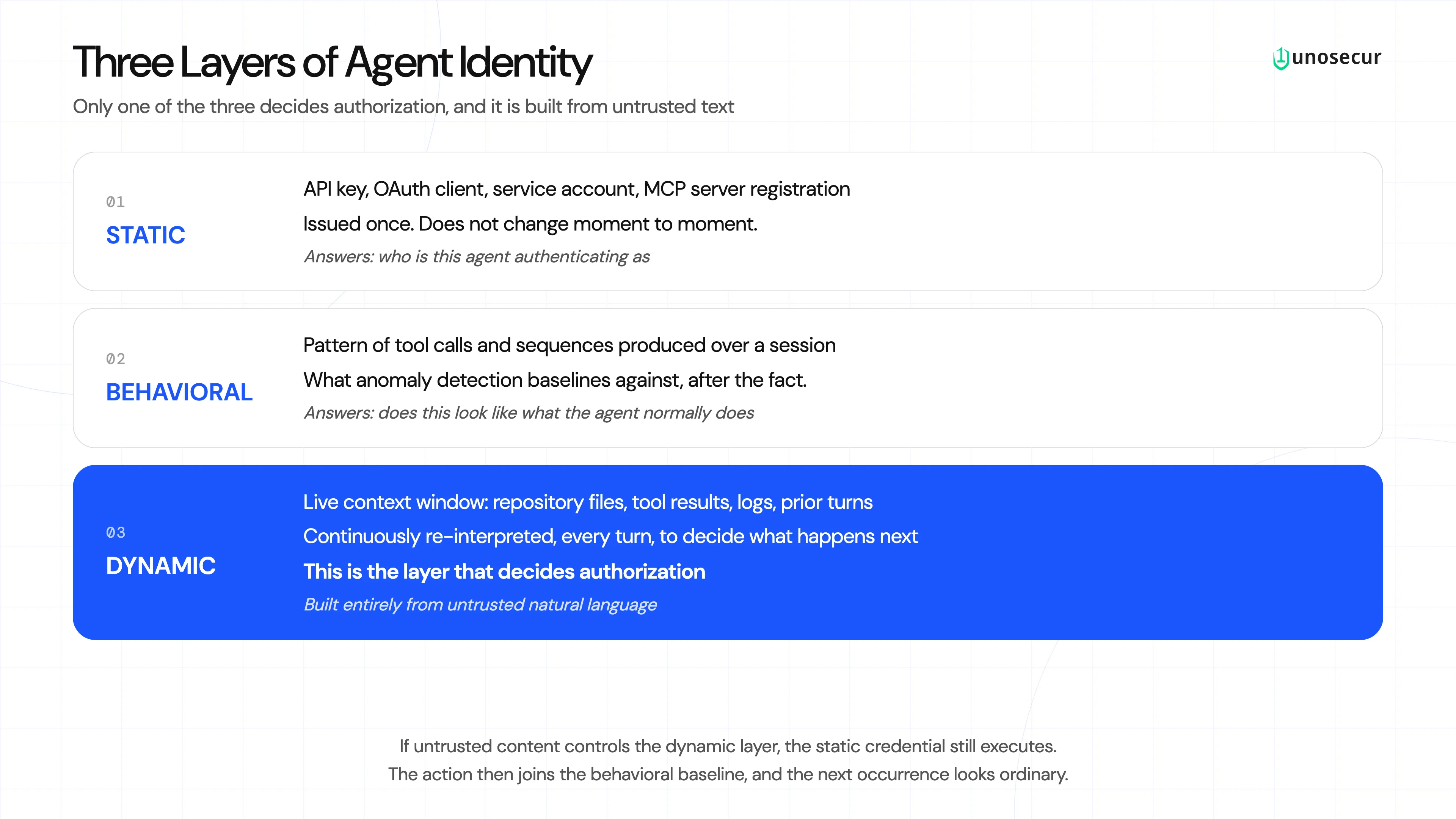
The dynamic layer can influence which authorized capability the agent exercises. If hostile content changes the agent's plan and produces a valid tool call, the static credential can still authorize the resulting action.
That action can then become part of the behavioral record used to understand normal activity.
Kimi's K3 launch material itself warns that the model may make unexpected decisions on a user's behalf when intent is ambiguous. Its training emphasizes acting on long-horizon goals instead of repeatedly asking the user.
For security teams, that creates a direct question: what prevents a mistaken agent decision from becoming an authorized external action?
Kimi Code's own documentation makes the case
The stronger evidence comes from Kimi Code's documentation rather than jailbreak screenshots.
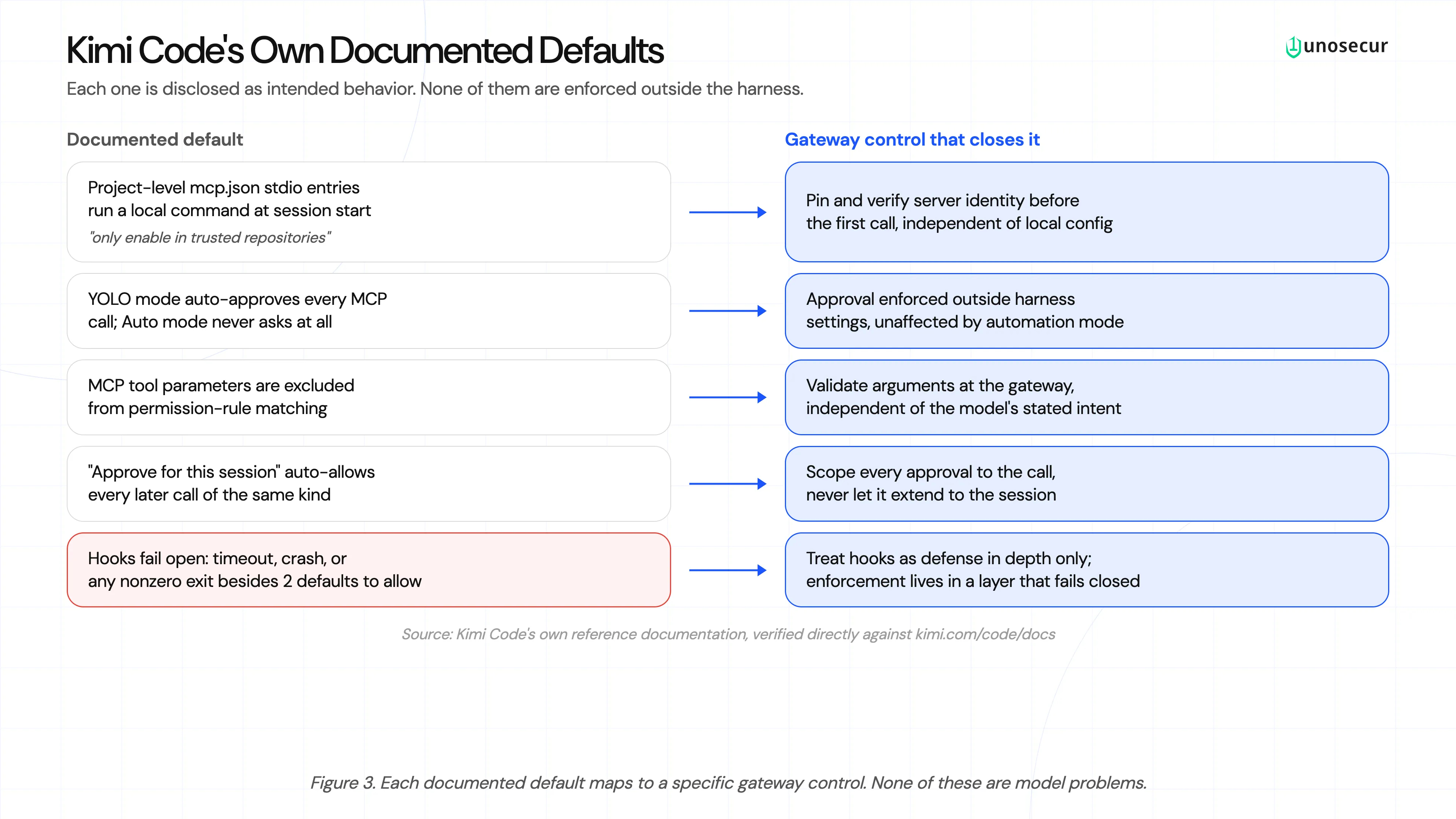
A project-level .kimi-code/mcp.json containing a stdio entry can execute a local command when a session starts. Kimi advises enabling this only in trusted repositories.
YOLO mode automatically approves every MCP tool call. Auto mode runs autonomously without asking.
Kimi Code's permission documentation also states that MCP tool parameters are excluded from permission rules. A rule allowing mcp__github__*, for example, approves the matching tool regardless of whether its arguments request a read operation or something more consequential.
Selecting "approve for this session" extends approval to subsequent calls of the same kind for that session.
Hooks provide another interception point. Exit code 2 blocks a tool call, but a timeout, crash, or other non-zero exit allows execution. Moonshot documents this behavior to prevent the normal agent workflow from being interrupted.
These are documented behaviors, not the two launch-day bugs. Each carries its own operating assumptions and recommended controls. Together, they show why agent security cannot depend entirely on the harness being configured correctly for every repository, session, and tool.
Where the fix actually has to live
If model behavior can influence the action, authorization needs an enforcement point outside the model. That control can evaluate the server identity, tool schema, arguments, provenance, and caller before execution.
Five controls follow directly from the examples above:
- Bind tool identity to server identity and schema version. CVE-2026-30856 in WeKnora allowed a malicious MCP server to register a tool whose normalized name collided with that of a trusted tool, thereby replacing its implementation.
- Validate arguments independently of the model's stated intent. Kimi Code's documentation confirms that MCP parameters are outside its permission matching.
- Scope approval to the required access window. Session-wide approval otherwise becomes standing access for later calls of the same type.
- Treat hooks as defense-in-depth rather than the sole enforcement layer, with failures defaulting to allow.
- Preserve provenance as structured metadata. CVE-2026-29783 in GitHub Copilot CLI demonstrated the danger of losing execution context when a command classified as read-only could use shell expansion to produce arbitrary execution.
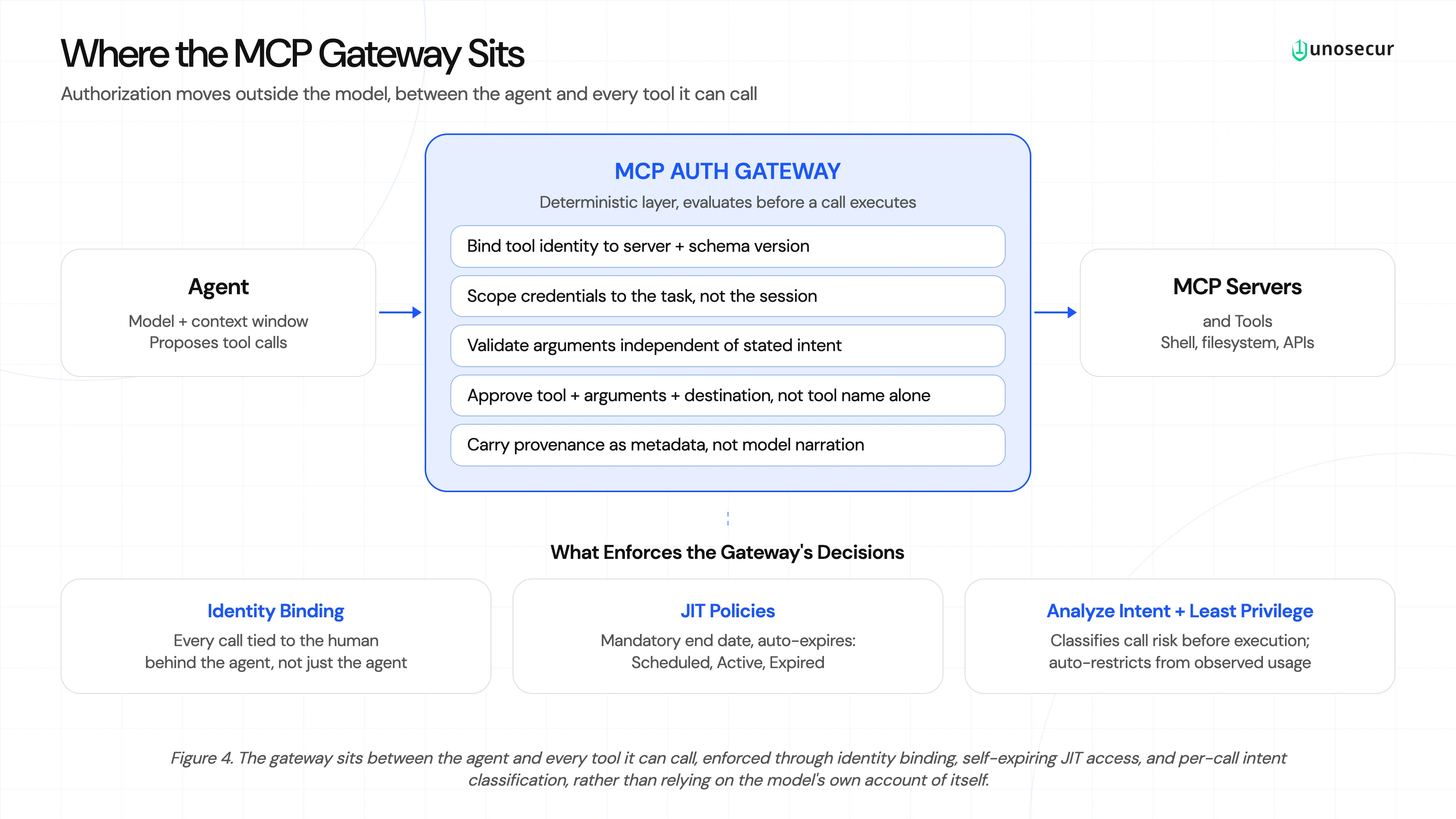
This is the control point Unosecur's MCP Gateway is built to occupy.
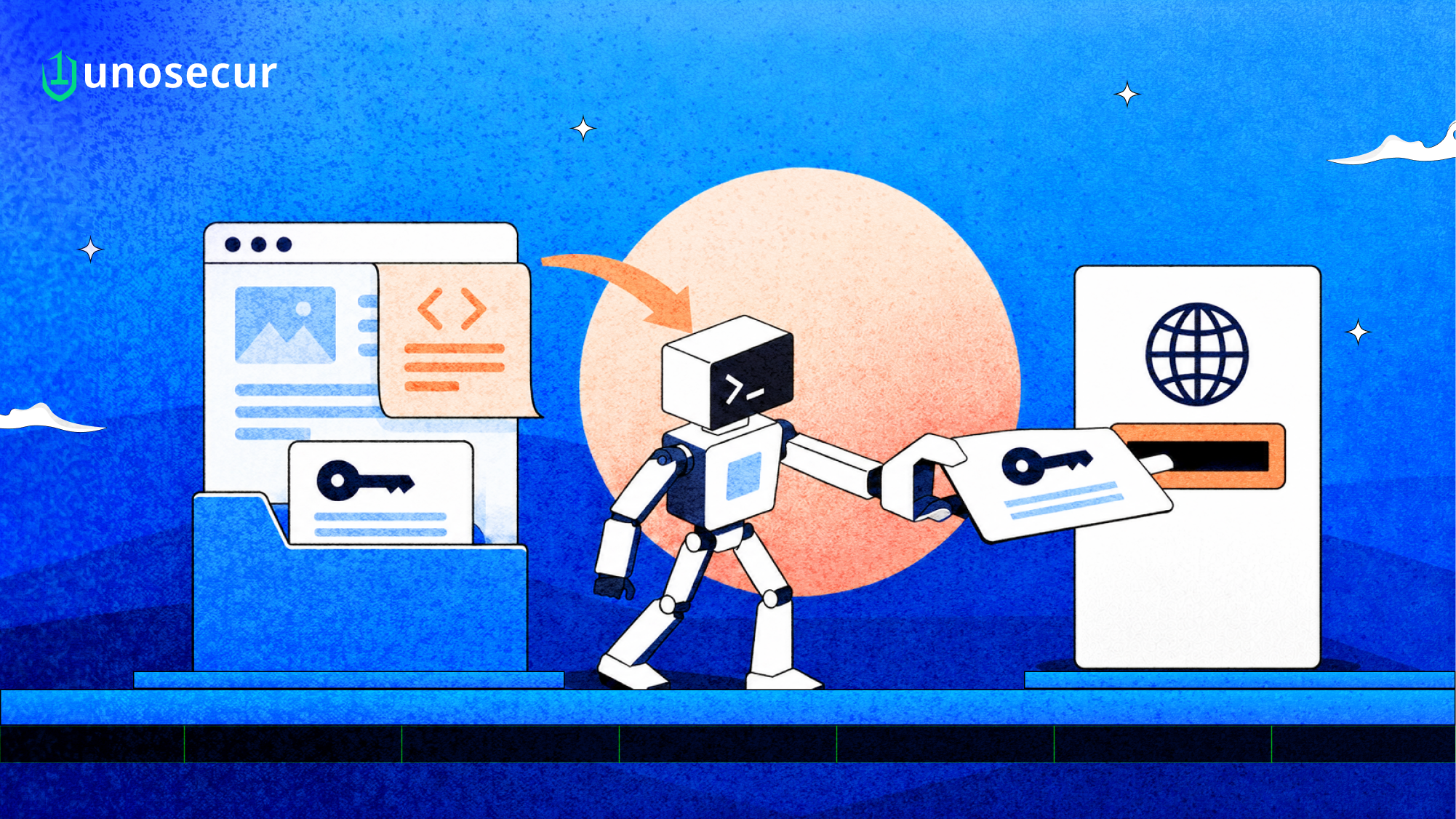
The gateway replaces direct client-to-server connections with a managed endpoint. AI clients authenticate through the gateway, which brokers access to MCP servers while keeping backend credentials out of the agent. Tool activity can remain tied to the human identity behind the agent instead of becoming anonymous agent traffic.
Enforcement then happens on the action itself. Analyze Intent classifies the purpose and risk of a call before execution, with separate flag and block thresholds. Where Kimi Code's permission matching stops at the tool name, this provides another control over what the requested action is trying to do.
Access can also expire. JIT policies carry a defined access window and expire automatically. Least Privilege policies use observed tool activity to identify unused access and restrict those tools.
The gateway does not replace fixes within an agent harness, the MCP server, or the underlying application. It adds an independent enforcement point for actions that remain technically available after those systems have made their own decisions.
Kimi K3 therefore raises a more useful question than whether one model can be jailbroken. Once an agent can act on repositories, cloud infrastructure, enterprise applications, or sensitive data, the important question is what it remains authorized to do after the model makes the wrong decision.
For teams connecting Claude, Cursor, VS Code, or other AI clients to enterprise systems through MCP, that authorization boundary needs to exist outside the agent.
See how Unosecur's MCP Gateway applies identity, time-bound access, least privilege, and per-call controls to agent-to-tool traffic.
.png)
.webp)
%201.svg)

.webp)

.avif)
.webp)