
.avif)





%201.svg)

Google Vertex AI
Integration
Your company deploys AI agents faster than it can secure them.
Unosecur brings them into one control plane to trace access, detect drift, and remove standing privileges.
.webp)
.webp)
Close the security gaps behind Vertex AI agents.
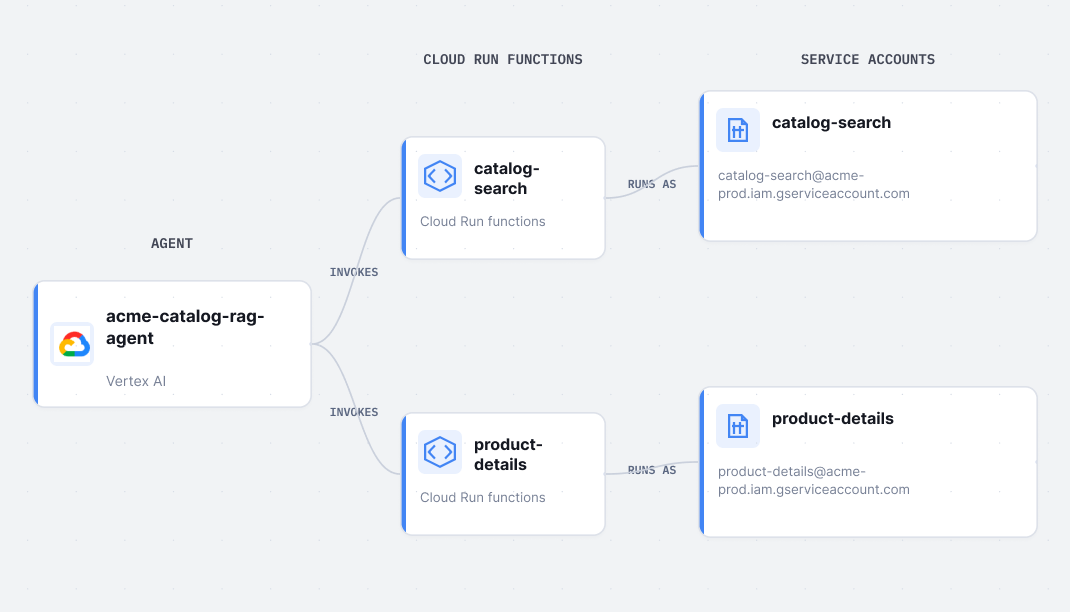
The agent visible in Vertex AI is only the starting point. Agent identity, service accounts, IAM roles, tools, memory, connected data, and activity determine the risks security teams must contain.
AI agent exposures living in your Google Cloud projects today.
Cloud security controls can show infrastructure and IAM. They do not by themselves explain the full agent context behind ownership, tools, data access, and runtime behavior.
.png)
Inherited default access
Agents and notebooks run on the default service account. That account usually holds Editor on the whole project, so the agent gets write access to everything.
Borrowed identities
One service account can mint tokens for another. An agent with modest permissions reaches far greater authority, and no single IAM policy shows the path.
Keys that never expire
Service account key files get pasted into agent code and shared between environments. They do not expire, they do not rotate, and offboarding does not revoke them.
Wide-open grounding
Grounding data stores sit on BigQuery tables and storage buckets with no row-level filter. Every caller gets the exact same unrestricted view of the data.
Audit logging off by default
Data access logging for Vertex AI is off unless somebody turns it on. Model calls and retrievals leave no record for your investigators to follow.
Agents in projects you do not watch
Teams create their own projects, folders, and regions. There is no organization-wide list of which agents exist or what each one can reach.
Integrations
One fabric across every AI platform below
Unosecur bridges cloud providers, identity platforms, and SaaS applications to bring agent behavior and authority into one strategic view.
.avif)




.avif)

.avif)
.webp)

Deploy AI agents fast. Secure them faster.
Discover every agent. Prioritize riskiest access. Reduce standing privileges.

%201.svg)






.avif)