





AI agent security is a comprehensive system of controls and architectural practices designed to prevent autonomous AI agents from becoming entry points or lateral movement vectors for attackers within an enterprise. It focuses on workload authentication, granular authorization boundaries, continuous behavioral monitoring, and containment mechanisms for all agent activities across corporate systems once deployed.
That distinction marks the critical divide between AI agent security and traditional chatbot or API security: Chatbots merely respond to user queries.
In contrast, an AI agent takes autonomous action: it reads customer support tickets and executes refunds, extracts records from production databases and updates CRM entries, or analyzes source repositories and commits code directly to production pipelines. Granting an agent broad access across corporate systems with zero continuous monitoring ensures that the consequences of failure are no longer hypothetical. According to research published by the Cloud Security Alliance (CSA), 65% of organizations experienced a cybersecurity incident involving an AI agent within the past year. Most of these incidents involved an agent exposing sensitive data it had legitimate permissions to access, but in ways never intended or authorized by security teams.
This comprehensive guide outlines the fundamentals of AI agent security, why it differs fundamentally from legacy application security, how it functions in production, key risks and attack vectors, common implementation pitfalls, and the governance frameworks that distinguish resilient deployments from vulnerable ones. You will also learn how Unosecur helps enterprise teams prevent AI agent security breaches.
Why is AI Agent security important?
AI agents do more than just analyze data; they take action. A coding agent can accept a pull request. A finance agent can approve a transaction. A customer support agent can issue a refund. All of those actions required human interaction in the past, someone with authorization and a paper trail. Now they happen in a matter of seconds, via systems authorized to perform specific functions, not to think on their feet.
This trend has elevated AI agents into a board-level priority rather than an engineering afterthought, aligning with the consistent trajectory highlighted across AI agent security news in 2026: incident rates rise in direct proportion to adoption. The sheer scale of non-human access is staggering. Research cited by the Cloud Security Alliance (CSA) indicates that non-human identities outnumber human identities by 45 to 1 across typical enterprise environments, surging to 144 to 1 in cloud-native architectures, and every single one of those identities requires defined ownership, bounded permissions, and automated offboarding mechanisms.
Your costs aren’t low either if you fail or something breaks, when it comes to your security AI agents. In the latest (and one of the best documented ones!) AI agent security news, a single agent was able to exploit nine Mexican government departments over seven weeks using the same type of AI coding tool found on many people’s computers, stealing hundreds of millions of records without even having to give any instructions themselves, says the security company that caught the breach. No nation-state level resources were required; just someone with access that they shouldn’t have been able to have.
AI Agent Security vs Traditional Application Security
Both these disciplines have a shared language in common – authentication, authorization, monitoring. However, beyond that, nothing matches. And here is where your security AI agents differ from traditional application security:
Benefits of AI Agent Security
The right security AI agent measures will pay dividends way before the first incident. Here are some of the main benefits of AI agent security:
You shrink the blast radius. An agent with just enough permissions for what it is doing cannot be made into a master key by over-privileging it. Teleport's 2026 research revealed that the incidence rate of security incidents of those organizations with least privilege enforcement policy is 17%, compared to 76% in those that don’t have such a policy, which is the biggest reduction in incidence rate of any control studied.
It makes incident response faster, too. When it comes to your security for AI agents, if each agent has its identity and audit logs, answering “What did it do?” will become an inquiry, not a forensics investigation through a maze of shared logs and generic service accounts.
Agent security will let you roll out new agents faster, safer. Teams of security professionals, who manage the AI agents security program, will be the only people capable of saying yes to a new AI agents application, instead of rejecting it until catching up with the development team’s needs. Compliance will be proactive, not reactive. Mapping the activities of the agent to compliance frameworks like OWASP Top 10 for Agentic Applications or NIST AI RMF becomes significantly easier when done as the agents are rolled out, not after an auditor asks about it.
How Does AI Agent Security Work?
You need 5 key layers of security for your AI agents. And, they run continuously, not simply audited once when deployed. Here is how AI agent security works:
- Discovery: Without knowing that an agent is out there, no one can secure it, which requires continuous discovery of all agents running in cloud accounts, SaaS systems, and developer tooling, even the ones that have been created without security's prior knowledge.
- Identity: Each agent receives its own identity, independent of both the developer who created it and all other agents, typically implemented via workload identity - a temporary, periodically rotated credential tied to the running process, in the style of SPIFFE, where a workload gets an identity certificate for a limited time rather than a hard-coded secret.
- Authentication and authorization: Your AI agent must authenticate its identity and be authorized only the rights it needs for this particular task, not unlimited rights to do anything and everything it could possibly do. The delegated access model where a human grants a scoped, timed credential for a specific purpose, in the style of OAuth, is taking off.
- Runtime monitoring. Because no one can predict in advance how an agent will behave, it requires security to observe what it is doing – what commands it runs, what data it accesses, whether its activity strays outside the norm.
- Containment: In case an agent becomes compromised or starts misbehaving because of a flaw or manipulated prompt (prompt injection), there must be a fast, reliable way to terminate its access or operation.
AI Agent Security Risks, Threats, and Attack Vectors
The OWASP Top 10 for Agentic Applications, published in December last year by the OWASP GenAI Security Project, is the closest thing this space has to a shared risk taxonomy. Whether the system in question is a coding assistant or a cyber security AI agent watching a SOC queue, the same categories apply:
- Goal hijack (ASI01). An attacker manipulates a cyber security AI agent, often through content it reads rather than a prompt a user typed, into pursuing a different objective than the one it was given.
- Tool misuse (ASI02). The agent has a legitimate tool and uses it in a way nobody intended, deleting instead of archiving, emailing a customer list instead of a team.
- Identity and privilege abuse (ASI03). The agent is over-permissioned relative to its task, so a single compromise reaches far more than it should.
- Insecure inter-agent communication (ASI07). One compromised or careless agent passes bad data or instructions to another, with no verification layer in between.
- Rogue agents (ASI10). An agent's behavior drifts, through compromise or its own errors, until it operates outside its intended purpose, sometimes without triggering an alert.
Two more patterns also show up constantly: shadow agents, tools spun up without security's knowledge on whatever credentials were easiest to grab, and credential sprawl, agents sharing long-lived API keys instead of their own scoped identity, so a leaked key can be replayed by anyone who finds it with no way to tell which agent was responsible.
Challenges in AI Agent Security
Even security teams that want to do this right run into the same handful of obstacles. Here are some of the challenges you might face with AI agents security:
- Visibility is the first. Agents get created inside a SaaS admin console, a developer's IDE, or a no-code platform, often without touching a request that would put them on security's radar, so teams end up governing the agents they know about and hoping the rest resemble them.
- The second is that agents don't behave deterministically. Traditional tooling flags known-bad patterns, but an agent can take a legitimate-looking path to a harmful outcome with no single rule that would have caught it.
- The third is ownership. A human-created account has an owner by default; an agent spun up by a workflow or another agent frequently doesn't, and when nobody's name is attached to it, nobody notices its access growing past what the task needs.
And the challenges of secure AI agents compound at scale: a handful can be reviewed by hand. Hundreds, each with scope that varies by user and task, can't.
AI Agent Security Best Practices
A few practices consistently separate organizations with a handle on this from organizations finding out the hard way, and most of what it takes to prevent AI agent security breach exposure comes down to habits, not tools. Here is how you can go about better securing AI agents with the best AI agent security practices:
- Inventory every agent first. Discovery is the prerequisite for everything else on this list.
- Give each one a named owner. An agent nobody's accountable for is an agent nobody notices going wrong.
- Default to least privilege, and least agency alongside it. Scope both what a secure AI agent can access and how much autonomy it possesses before requiring human-in-the-loop validation.
- Replace shared, long-lived API keys. Instead, replace them with short-lived, per-agent credentials that expire on their own.
- Don’t ignore human approval gates. Gate high-stakes actions, payments, deletions, external emails, behind human approval or just-in-time access.
- Log your tools with detailed contexts. Log every tool call with enough context to answer “what did this agent do, and on whose authority” after the fact.
- Test, test, and test your AI agents. Test agents against prompt injection and goal hijacking the way you'd pen-test an application, before an attacker does.
- Map controls to recognized frameworks only. We recommend the OWASP Top 10 for Agentic Applications and NIST's AI RMF right now, so gaps show up in reviews instead of incident reports.
- Build and actually test a kill switch. An untested containment plan is one you're hoping never to need.
AI Agent Security Use Cases
AI agent security looks different depending on what the agent is actually doing. A few of the most common patterns:
- Coding assistants. Tools like Claude Code or GitHub Copilot's agentic modes read a repository, write code, and merge pull requests. The risk: standing access to source code, secrets, and CI/CD pipelines, often under a developer's own broad credentials.
- Customer support agents. These read tickets, pull customer records, and can issue refunds or reset accounts, putting CRM and PII access alongside financially meaningful action with no human in the loop.
- Security operations agents. An AI security agent triaging alerts across a SOC needs read access to nearly everything, making it one of the highest-value targets in the environment if it's ever compromised.
- Finance and procurement agents. Agents that approve invoices or initiate payments combine sensitive data access with direct financial impact, exactly what attackers look for.
- IT and DevOps agents. These provision infrastructure and rotate credentials, so a manipulated agent here doesn't just leak data, it can change the environment itself.
- Research and browsing agents. Agents that read external content to complete a task are exposed to indirect prompt injection: instructions hidden in a page that the agent treats as legitimate input.
How Unosecur Helps Secure AI Agents
Most of the risks above come down to the same root problem: an agent with access nobody is actively governing. Unosecur's Unified Identity Fabric closes that gap by discovering every human, non-human, and AI agent identity across an environment, and mapping exactly what each one can reach.
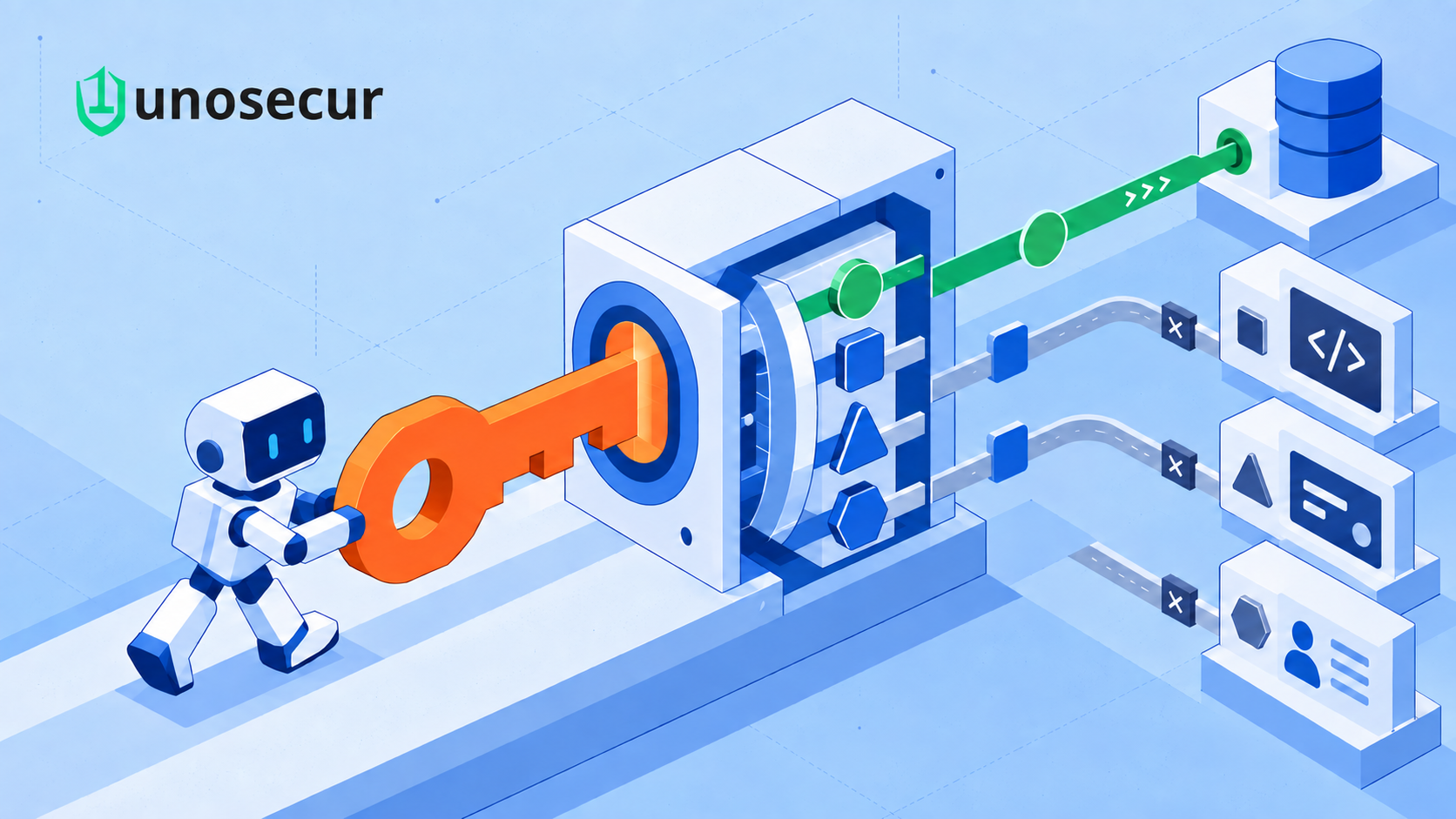
For agents specifically, the MCP Auth Gateway sits between every AI agent and the systems it touches. Agents authenticate through the gateway instead of holding standing credentials, sensitive tool calls get time-bound approval, and every request is logged with full attribution, turning “what did the agent do” from a forensic question into a lookup.
Unosecur's AI agent security and compliance features include 60+ detection rules mapped to the OWASP Top 10 for LLM Applications, tied to identity behavior rather than model output alone, plus built-in evidence generation for SOC 2, HIPAA, ISO 27001, ISO 42001, GDPR, NIST AI RMF, and the EU AI Act.
For enterprises with strict cross-border compliance mandates, Unosecur is a platform to consider for securing AI agents while maintaining EU data sovereignty. Organizations can deploy Unosecur within sovereign German cloud regions, customer-dedicated private clouds, or fully air-gapped on-premises environments, ensuring agent activity logs, credentials, and telemetry remain strictly within European boundaries.
The result treats agent AI security the way it should have been treated from day one: every agent as a first-class identity, scoped to least privilege, with the visibility and containment to back it up when something goes wrong.
Conclusion
AI agent security cannot be treated as an afterthought bolted onto agents already operating in production; it is the identity and access foundation that must precede deployment. Organizations facing severe incidents are rarely those adopting AI cautiously; they are the teams rapidly deploying agents without establishing clear identity ownership, granular permission boundaries, or instantaneous kill switches.
Just do an honest inventory check on what you've got, treat each agent as an identity, assume least privilege/least agency by default, and build your containment path ahead of time, before you need it. That covers a lot of the difference between good governance and bad governance when it comes to AI agents, and that’s also how you close your biggest blind spots at the same time.
Frequently Asked Questions
AI agent security involves the practice of verifying, authenticating, authorizing, and monitoring self-operated AI entities to ensure that their access and behavior remain within the requirements of the particular task at hand: identity, credential, permission scope, runtime monitoring, and the ability to disable the AI entity if it operates outside of its intended purpose.
Because your agents can actually do something, not just simply respond. When an agent has access to a system, it can manipulate money, manipulate data, or run programs with far less supervision than would be necessary for a human performing the same task. Without controls, that access goes ungoverned at precisely the points where mistakes can be costly for your business or organization.
Over-permissioned access, prompt injection and goal hijacking, tool misuse, shadow agents nobody in security knows about, and insecure communication between agents in multi-agent systems.
Inventory every agent, give each one a named owner and its own identity, scope permissions to the specific task rather than standing access, replace shared static credentials with short-lived ones, monitor behavior at runtime, and keep a tested way to revoke access immediately.
Treat each agent as a first-class, non-human identity rather than a shared service account: a distinct identity per agent, a named owner, short-lived auto-rotated credentials, and continuous discovery so agents created outside a formal process still show up instead of staying invisible.
Through short-lived, scoped credentials tied to the agent's own workload identity, not long-lived API keys shared across services. Standards like SPIFFE issue a temporary certificate to the running process itself, while OAuth-style delegation lets a human grant a scoped, time-boxed token instead of handing over standing access.
Use mutual authentication between services with short-lived tokens, scoped to the specific operation, with every call authorised against a central policy. Static API keys shared across services are the most common failure mode. Workload identity, mTLS, and per-call authorisation through a gateway layer remove the shared-secret problem. The MCP Auth Gateway extends this pattern to agent-driven calls.